End-of-Year Appeal: How to Devise the Perfect Strategy (+ Free Samples)
Discover how to build a winning appeal strategy that will ensure your year-end campaign brings in significant funding for your mission.
Updated on

Discover how to build a winning appeal strategy that will ensure your year-end campaign brings in significant funding for your mission.
 Join the fundraising movement! Join the fundraising movement!
In 2025, nonprofits brought in 37% of all online revenue in the month of December. Think about that: more than a third of all donations came through during the last four weeks of the year.
That’s why your end-of-year appeal strategy is more important than ever. But writing impactful appeals, choosing the right tools, applying the ample advice you find on the internet…it can feel impossible when you’re already swamped.
I’ve broken the process down into seven key steps to create the perfect year-end appeal strategy. I’ll also share a sample timeline and budget to help you plan.
First, you need to understand who your appeal will reach.
At the start of your campaign plan, you’ll want to segment donors based on the following factors:
Understanding your donors better will help you determine the best way forward for your campaign.
For example, you might find that the majority of donors who gave in December of last year mailed in a check. That tells you that a direct mail play is in order. However, if nearly all of them gave online, you may be able to save some of your budget by focusing solely on online appeals.
Or, you may find that the majority of your donors are interested in a specific program your organization runs. You can then include storytelling about this program in your appeal for greater impact.
Ideally, you’ll use a CRM or donor database that allows you to save these segments for future reference.
If you conducted a SWOT analysis after your year-end appeal last year, now’s the time to review your notes.
Either way, reflect on what worked and what didn’t work. Dig into your donation data from that time, too, to determine how financially successful your appeal was.
What did your appeal focus on? Was it mailed, emailed, and/or shared on social media? What fell short of your expectations?
This data will help you construct a fundraising goal and create a strategy.
Now you’ll apply the information you gathered in the steps above to select the method of distribution for your appeal and the tools you’ll use to do it.
Traditionally, email and direct mail are common avenues for delivering appeals. Here’s a closer look at how these methods compare:
| Direct Mail | |
|---|---|
| Average conversion rate of 4.4% to 4.9% | Average open rate of 28.59% with a click-to-open rate of 10.2% |
| Pro: Easier to stand out in a mailbox, good relationship-building tool | Con: Lots of inbox competition |
| Con: More material expenses than email | Pro: Affordable option, with many free or inexpensive email marketing platforms |
| Con: Giving may require more steps | Pro: Giving is completed in a few clicks |
Social media is another channel for sharing end-of-year appeals, and it comes with its own pros and cons.
Once you choose which channels you’ll focus on, you’ll have a better idea of what to include in your appeal.
What you share in your appeal is important. But the giving options you offer are arguably more important.
A donor can be very moved by your appeal, but if their preferred method of giving isn’t available, they may lose steam and not complete their gift.
Here are some giving options you should consider offering:
Choose a fundraising platform that offers all of these options, like Donorbox. Donorbox’s OmniGive™ Donation Form offers over 22 payment methods that automatically render based on a donor’s device and location – meaning they never see too many options.
Year-end giving is the perfect time to upgrade one-time donors to ongoing supporters. Add a gentle nudge during your checkout process that encourages donors to go monthly.
In your appeal, you can share how monthly support serves your mission and any exciting programming coming up the following year that monthly donors will directly support.
Establishing a culture of storytelling is vital to creating impactful donor communications and appeals.
Start by collecting internal stories. Ask the following to share their experiences:
Then work externally, connecting with beneficiaries who might be willing to share how your organization has impacted their lives. Be sure to follow ethical storytelling guidelines and respect your beneficiaries – this guide has a great framework to follow.
People respond best to stories, especially when they’re about other people. A personalized story that speaks to your donors’ passions and interests raises awareness, encourages more donations, and spreads the word about your organization.
You should also add real images and videos to digital appeals to boost giving – but they don’t necessarily belong in a mailed appeal letter.
Now you’ll need a place for your campaign to live online – somewhere where donors can give in a streamlined, attractive process that reflects your brand.
The golden thread of your campaign (the main through-line of the story or messaging) should be carried over to your donation page. Include images that illustrate your point and evoke donor emotion to keep the momentum going through the end of the donation.
You should choose a fundraising platform that allows you to fully customize your donation form to match your brand. In addition to being fully customizable, Donorbox’s OmniGive form can be embedded directly on your website or hosted on a Donorbox donation page for easy setup.
See how FLY raised over $340,000 for their year-end campaign in 2025:
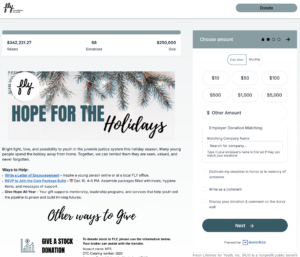
For more tips, check out this guide to building a successful donation page.
Now that you have your beneficiary stories, a donation page, and donor segments all in place, it’s time to actually write your year-end appeal letter, email, or social media posts.
Be sure to personalize your email and direct mail appeals with salutations, ask amounts, and an impactful closing.
Here are some tips:
Need some inspiration? Fundraising experts on our team came together to create this free downloadable resource that includes examples of a mailed appeal, emailed appeal, and social media post. 
As you craft your appeal, there’s one group in particular you need to address carefully: your major gift prospects.
These are the donors or potential donors who you know have the potential for a large gift.
Ideally, you’ll take a completely customized approach that includes meeting with these prospects to understand their philanthropic priorities and interests. Your appeal narrative should be adjusted to address them – their interests, capacity, and giving preferences.
I’ve walked you through the steps required to craft brilliant year-end appeals. Now here’s an example of how I would time out each step.
| Date | Step |
|---|---|
| October 12 | Segment donor lists |
| October 19 | Research past successes and failures |
| October 26 | Add exciting giving options |
| November 2 | Find compelling stories |
| November 16 | Prepare a donation page |
| November 23 | Write your year-end appeal |
| December 7 | Launch your appeal |
| December 16 | Send first follow-up |
| December 28 or 29 | Last communication of the year |
The bulk of the preparation work should take place in October, with actual crafting of the appeal materials focused in November. Then December is reserved for launching and communicating with donors, reminding them of the tax-year deadline as the year draws to a close.
The cost of your end-of-year appeal depends on which channels and tools you choose.
Let’s say you plan to use both direct mail (500 addresses with a follow-up letter) and email, along with some paid social media ads. Here’s what your budget might look like:
| Item | Cost |
|---|---|
| Freelance graphic designer | $300 |
| Direct mail materials and printing | $400 |
| Postage (with nonprofit rate) | $190 |
| Social media ads | $400 |
| Total | $1,390 |
As you can see from this example, expenses really do vary depending on the scope of your end-of-year appeal, the tools you rely on, and any external support you need.
Looking for inspiration? Check out this series of mailed, email, and social media appeals that combine to form a cohesive and impactful end-of-year fundraising campaign.
First, I recommend sending your mailed year-end appeal letter, like this one:

Then, launch your email campaign with an email appeal. Notice in this sample that we’ve adapted the messaging from the mailed appeal letter – no need to start from scratch!

Be sure to follow up your first email appeal with a second that increases the sense of urgency as your campaign winds down, like this one:

Throughout your campaign, take your appeal to social media by breaking up your beneficiary’s story across several posts. This keeps your audience engaged and coming back for more – plus, it makes donors feel as if they are helping a beneficiary in real time. Be sure to add a campaign-specific hashtag to tie them all together!
Here’s a close-up of a social media appeal:

And here is a sample of what a series of social posts could look like as part of your year-end fundraising campaign!

Finally, you should always thank your donors throughout and following every campaign! Here’s an example of a thank-you email:

In 2026, Giving Tuesday falls on December 1st – meaning December will be crowded with both Giving Tuesday and year-end appeals.
That’s why it’s more important than ever that you approach your year-end appeal carefully and with strategy. How will this appeal differ from Giving Tuesday? How will it differ from other organizations in your area who will also be sending out compelling asks?
There’s something that makes your organization 100% unique. Lean into it, and you’ll be sure to have a successful end-of-year appeal.
As always, Donorbox is here to support you with industry-leading tools and friendly support. Sign up today and start fundraising in under fifteen minutes.


Lindsey Bower is a writer, content strategist, and nonprofit consultant. She specializes in helping nonprofits craft compelling messaging for websites, blogs, social media, and email marketing, with a strong focus on SEO and AEO strategy. With a background in fundraising and membership management, she knows firsthand what it's like to juggle priorities and wear many hats in the fast-paced nonprofit world.

 Join the fundraising movement! Join the fundraising movement!