Why Smart Nonprofits Invest in Better Software
As the saying goes, there’s no such thing as a free lunch. When it comes to investing in fundraising software, the cheapest option may not always be the best.
Updated on

As the saying goes, there’s no such thing as a free lunch. When it comes to investing in fundraising software, the cheapest option may not always be the best.
 Join the fundraising movement! Join the fundraising movement!
As a nonprofit leader, you’re probably an expert at stretching every dollar to maximize your impact.
But more often than not, you get what you pay for. The tools you invest in play a critical role in how your team operates, engages supporters, and meets your fundraising goals.
Below, I’ll explain how investing in quality nonprofit software saves you time, strengthens donor relationships, and enables long-term growth.
Traditionally, nonprofit organizations feel pressured to operate with minimal administrative and fundraising expenses.
When a nonprofit publicly shares its financial statements, some donors scrutinize how much of their donations are allocated toward programs versus overhead costs.
Organizations with lower overhead costs may be perceived as making better use of donor dollars, even when that assumption doesn’t paint the full picture. Donors want their dollars to go toward the mission – and not administrative expenses.
While avoiding unnecessary costs is still important, investing in staff, technology, marketing, and other crucial areas is fundamental for building a sustainable nonprofit.
With the right tools and technology at your disposal, you’re positioned to foster stronger donor relationships and raise more funds, ultimately allowing you to do more good.
Everybody loves a bargain, especially when you’re working with a fundraising budget that doesn’t leave much wiggle room.
While zero-fee platforms can seem attractive in the moment, they often come with trade-offs that aren’t initially obvious.
These often include:
For example, let’s look at Zeffy. Zeffy is a fundraising platform that operates on an optional donor tipping model to sustain its free business model.
While it is indeed free to use, it requests high tips from donors, over and above the typical cost of platform and transaction fees. For gifts up to $99.49, the default tip percentage is 17%. For donations above $99.50, the tipping percentage starts at 15%.
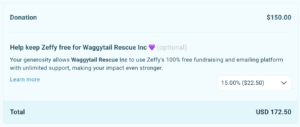
The ability to omit the tip isn’t immediately obvious either, which can cause confusion, frustration, and tipping fatigue among donors.
Fundraising platforms that transfer their operational costs to donors may create a less favorable giving experience, which can influence conversion and churn rates over time.
In addition to requesting optional tips, heavy platform-specific branding and unnecessary scrolling can create doubt and add friction to the donation process.
When supporters visit your donation page, they expect to see your nonprofit’s branding and the ability to donate quickly.
If they’re met with a form that has too many fields, a complex checkout flow, and excessive branding that doesn’t align with your nonprofit, they may hesitate and abandon their gifts.
In the end, if the giving experience doesn’t signal trust, it may cost your organization those hard-earned donor gifts and relationships you’ve worked so hard to build.
Now, I’ll highlight why a quality nonprofit fundraising platform is a worthwhile investment for your organization.
Providing donors with a quick giving experience that signals trust is how you’ll encourage them to follow through with their gift and give again in the future.
Investing in a solid nonprofit fundraising platform typically offers the following benefits:
Many platforms offer inexpensive solutions that prioritize the donor experience while meeting your fundraising budget.
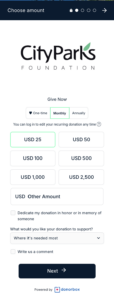
For example, the Donorbox OmniGive™ Donation Form is designed to help organizations like yours capture more generosity with 25+ payment methods, advanced customization options, and a conversion-optimized checkout.
Donorbox is free to start, too, with a platform fee of 2.95% for most features, plus standard payment processing fees – both of which you can always ask donors to cover. Learn more about pricing plans here.
Here’s an example of City Parks Foundation’s branded OmniGive donation form:
Start Fundraising with Donorbox
Providing a positive donor experience is essential for capturing more generosity and letting supporters know you value their time and money.
Building lasting relationships with your donors is crucial for the success of your mission. After all, their donations are what make your meaningful work possible.
Good nonprofit software makes it easy to maintain those relationships and simplify your outreach.
Many platforms offer advanced donor management tools to streamline relationship-building while improving engagement and communication. The right software enables you to:
Bonus points if your software includes a nonprofit CRM with email marketing capabilities. For example, Donorbox CRM (coming soon) lets you cultivate lasting donor relationships, track every donation, and strengthen your outreach with built-in email marketing for maximum impact.
Your nonprofit is probably already operating with limited resources. Investing in quality fundraising software lets you automate repetitive manual tasks that take away time from your mission.
Strong nonprofit software streamlines your workflow by:
Automation and user-friendly features like these free up time so you can invest more in campaign planning, donor stewardship, and fundraising appeals.
A steady stream of fundraising revenue is essential for your nonprofit’s growth and sustainability.
One of the best ways to create stability is through recurring giving. In 2025, recurring giving accounted for 27% of all online revenue, and that percentage is on track to keep growing.
Quality fundraising platforms like Donorbox enable you to convert more one-time donors into long-term supporters through gentle upgrade prompts and multiple recurring interval options. Plus, supporters can manage their recurring donation plans at any time.
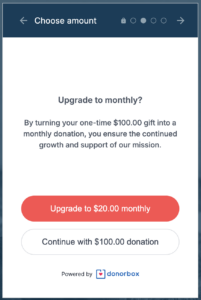
Investing in a comprehensive fundraising platform enables diverse fundraising and consistent revenue.
When donor and fundraising data is inaccurate or spread across multiple spreadsheets, pulling reports and making informed decisions can prove challenging.
Scattered or conflicting data can also lead to missed fundraising opportunities.
Reputable nonprofit fundraising software collects and centralizes all your data for easy analysis, reporting, and decision-making. And it keeps that data clean and updated.
With accurate data and helpful reporting tools on hand, you’re better equipped to track fundraising and campaign performance in real time, generate reports quickly, and provide clearer updates to board members.
While cost is an important consideration for any nonprofit, your fundraising software should be viewed as an investment to streamline your operations and improve fundraising efficiency.
What appears as savings now may cost you in the form of lower conversion rates, negative donor experiences, reduced functionality, and more manual work.
Investing in good-quality nonprofit software is important for your mission and impact over time.
Donorbox, for example, offers robust fundraising features and donor management tools designed to support your long-term growth while strengthening supporter relationships.
Interested in trying it out? Sign up today.
For more nonprofit tips and fundraising ideas, check out the rest of the Nonprofit Blog. And subscribe to the monthly newsletter for a hand-picked selection of resources sent to your inbox.

Jamy-Lee has over 7 years of experience in copywriting and content marketing. With experience teaching in underserved communities and volunteering for animal rescue organizations, she has a first-hand understanding of the challenges faced by mission-driven organizations. She now uses her passion for writing to share practical insights that help nonprofits fulfill their missions.
 Join the fundraising movement! Join the fundraising movement!