See for yourself how easy fundraising can be with Donorbox.Watch the Demo now
Donation Receipts: Ultimate Guide for Nonprofit Organizations
You know donation receipts are important, but maybe you don’t understand why. Keep reading to learn why they matter, what you need to include, and how to automate them.
Updated on : Added FAQs, donation receipt requirements, decision-making criteria, a free resource and an expert quote, and a comparison of donation receipts vs. acknowledgement letters.
Join the fundraising movement!
Subscribe to our e-newsletter to receive the latest blogs, news, and more in your inbox.
Join the fundraising movement!
Subscribe to our e-newsletter to receive the latest blogs, news, and more in your inbox.
Sending a donation receipt isn’t just a nice gesture. In many cases, it’s required.
Donation receipts help meet IRS requirements, track donations, and build strongerrelationships with donors while maximizing engagement.
In this article, I’ll walk you through everything you need to know about nonprofit donation receipts, what’s required, and how to automate them.
Key Takeaways 💡
Send donation receipts promptly and include important information. Aim to share a receipt within 24 to 48 hours after a donation is made, and include the relevant information donors need for their records and tax purposes.
Personalize the receipt. Include the donor’s name, thank them for their gift, and highlight the impact of their support.
Consider sharing a year-end tax receipt with donors. While not required, sending year-end receipts is a nice gesture and provides donors with a consolidated summary of their gifts so they have one clear record when preparing for tax season.
What are Donation Receipts?
A donation receipt is a formal acknowledgement sent to a donor to confirm the receipt of a donation.
At its core, a donation receipt gives a donor peace of mind that their donation has made it to the intended recipient. But it also shares important information that is required if your organization falls under certain IRS tax-exempt designations.
And, of course, it’s an important step for building a relationship of trust and accountability with your donors.
When to Send Donation Receipts
A good rule of thumb is to send donation receipts within 24 to 48 hours of receiving a donation. Many nonprofits manage this by automating donation receipts for online donations. More on how to do that below!
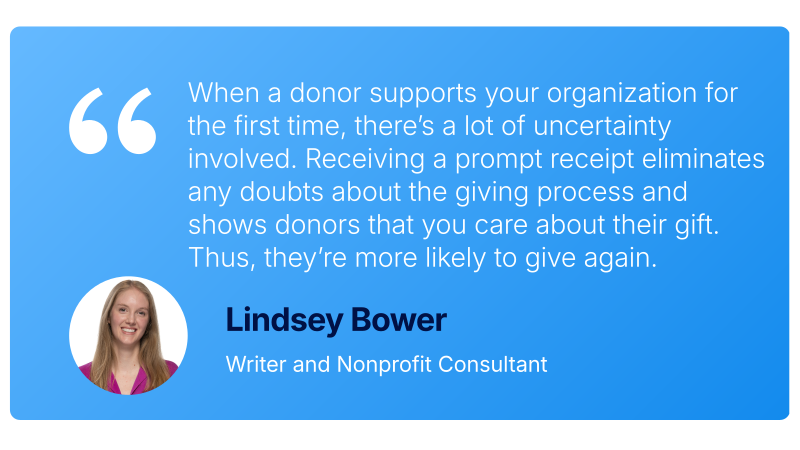
Sending donation receipts ASAP meets your donors’ expectations for prompt acknowledgement. It also helps improve first-time donor retention.
Types of donation receipts
There are a few types of donation receipts you’ll need to create. These include:
Let’s take a look at what information is required for your donation receipt.
Requirements for Donation Receipts
Tax-exempt nonprofits are required to provide donation receipts for the following giving situations, according to IRS Publication 1771:
A single donation greater than $250 has been made.
A donor received goods or services in exchange for a single donation greater than $75 (called a quid pro quo contribution).
A donor has requested a receipt.
Note: If a donor has an annual membership with your nonprofit organization, they don’t technically need a receipt if the annual cost is $75 or less and goods or services were provided in exchange.
While these are the situations where a donation receipt is strictly required, it’s good practice to send a detailed receipt for donations of every size.
What to include in a donation receipt
Here’s what U.S. nonprofits are required to include in their donation receipts:
Name of the organization that received the donation
A statement that the nonprofit is a public charity recognized as tax-exempt by the IRS under Section 501(c)(3)
Name of the donor (accurate donor information)
The date of the donation
Donation amount
Description (but not value) of any non-cash contribution (the nonprofit should not attempt to assign the cash value of property; doing so is the donor’s responsibility)
A statement that no goods or services were provided by the organization (if applicable)
Description and good faith estimate of the value of goods or services, if any, that the organization provided in return for the contribution
A statement that the organization did not provide more than insubstantial goods or services in return for the donation, such as, “No goods or services were received in return for this gift.”
If your organization provides intangible religious benefits, be sure to include a statement like, “The organization provided intangible religious benefits or services to the donor.”
Include your physical mailing address and Employer Identification Number (EIN) to confirm your tax-exempt status. Although not required, donors will need to provide this information with their taxes, so you’re saving them the effort of looking it up.
Pro tip: Be careful with year-end giving, when a donor could mail a check on the last day of December that you won’t receive until January. List the December date (the date the check was postmarked) on the receipt to ensure your donor has no issues come tax season.
There are different rules to follow on a donation receipt depending on where you live, so it’s best to go directly to your government’s website to check for accurate information, especially since rules and regulations can change.
Let’s take a closer look at two types of donation receipts that trip up nonprofits.
In-kind donation receipts
Let’s say a wealthy donor chooses to give your school ten computers as an in-kind donation – meaning, instead of giving you the cash to buy the computers yourself, the donor provides them directly.
In-kind donations can also include situations such as a lawyer providing a pro bono consultation or an artist painting a mural on your building.
Sending donation receipts for in-kind donations is crucial. But many nonprofits get caught up on just what to include in those receipts.
Here are some guidelines for completing in-kind donation receipts:
Detail the gift received, but do not assign a monetary value
The donor is responsible for documenting and claiming the monetary value for tax purposes.
So in the example above, it would be the responsibility of the donor to document how much they spent on those ten computers if they wish to deduct that amount from their taxes.
Yearly donation receipts
A yearly receipt shows a consolidated outline of every gift given, making tax reporting easy for donors. While not required, sending yearly donation receipts is a nice gesture for donors who have given often throughout the year.
Typically, you’ll want to choose a donation platform that makes this process seamless. Donorbox, for example, offers a quick and easy way to generate and send year-end receipts so you can cross this task off your list.
Free Donation Receipt Template
Worried you might miss something on your receipt? I’ve got you covered. Download this free Donation Receipt Template.
Donation Receipt vs. Acknowledgement Letter
What isn’t a donation receipt? An acknowledgement letter.
While these two donor communications often go hand in hand, a formal donation receipt for tax purposes has different requirements than an informal acknowledgement letter.
Here’s a breakdown of how these documents differ:
Donation Receipt
Acknowledgement Letter
Purpose: To provide clear details about a donation. Often used by donors to claim donations on their taxes.
Purpose: To show genuine appreciation for a donation and steward a stronger relationship with a donor.
Required for certain donations, but it’s a good practice to send to all donors.
Not required, but it’s a good practice to send to all donors.
Must include specific information.
No required information.
Sent 24 - 48 hours after a donation.
Sent ASAP after a donation, up to one week.
Nonprofits sometimes use these terms interchangeably. While they’re both important, they ultimately serve different functions.
How to Automate Year-End Tax Receipts
As I mentioned above, most nonprofits stay on top of their donation receipt timing by automating receipts for all digital donations using a platform like Donorbox.
With Donorbox, you can fully customize your donation receipt text. Once a donation comes in through your Donorbox donation form, your donor will receive the receipt automatically.
Here’s how to create and automate a 501(c)(3)-compliant receipt with Donorbox:
Log in to yourDonorbox dashboard and select one of your campaigns. Click the “Edit Campaign” icon.
Scroll down to “Receipt Emails.”
Use the easy template editor to customize your receipt content.
Once you save the changes, your receipts will automatically go out every time you receive a new donation.
You can also access general receipt settings on your Donorbox account under “Engage.”
From here, you can set a “reply to” email address in case the donor wants to reply to the donation receipt email, improving the overall donor experience.
How to Choose the Best Donation Receipt Software
Not all donation receipt software options are alike. Look for one that meets the following criteria:
Allows variables in the subject line, like first names.
Manages all receipt sending automatically.
Allows setting a reply-to address to catch any donor queries.
Can handle international currency types with ease.
Donorbox offers all of these features and more. Learn more about Donorbox’s receipt features here.
Over to You
Without the right tool, donation receipts can be confusing and time-consuming. But they’re an important part of building a relationship of trust and transparency with your donors.
Familiarize yourself with your country’s donation receipt requirements. Then, invest in the right fundraising tools and software, like Donorbox, to make the process easier and free up your time for more important fundraising tasks.
Disclaimer: By sharing this information, we do not intend to provide legal, tax, or accounting advice, or to address specific situations. This article is intended to provide generalized financial information designed to educate a broad segment of the public. Please consult with your legal or tax advisor to supplement and verify what you learn here.
Donation Receipt FAQs
1. What are the IRS rules on donation receipts?
Qualified, tax-exempt organizations are required to provide a donation receipt for any contribution of $250 or more before a donor can claim a deduction on their taxes. Similarly, donation receipts are required if goods or services were exchanged for the donation and if a donor has requested a receipt.
2. Do you need a receipt for donations under $250?
No, you do not need a formal donation receipt for any donations under $250 as long as no goods or services have been exchanged (which is called a quid pro quo donation). You do need to have a reliable record of the donation, such as a bank statement.
Ilma is a content writer with over eight years of experience, specializing in nonprofits and social impact, marketing, language, and psychology. She draws on years of volunteering in the nonprofit sector to craft thoughtful, research-informed pieces. Ilma is also a therapist passionate about mental health and often weaves this perspective into her writing.

 Join the fundraising movement!