See for yourself how easy fundraising can be with Donorbox.Watch the Demo now
Making the Most From Nonprofit Donor Database – The Ultimate Guide
Without a donor database, you risk losing crucial donor details and connections that help your nonprofit grow. Below, I’ll explain which essential database features you should look for, and recommend donor database solutions.
Building strong donor relationships is crucial for fundraising success, and a quality donor database makes it easy to effectively manage those relationships.
There are several database options available for nonprofits like yours to securely store and manage donor data while integrating with leading CRMs that improve your communications, reporting, and more.
In this article, I’ll list the features you need and share five of the best nonprofit databases to help you make a decision.
11 Essential Features and Add-on Functionalities to Look for in a Nonprofit Donor Database
Features
1. Thorough supporter profiles
Donor databases collect enough donor information to develop an overall picture of the donor and their connection to your organization.
They collect donation amounts, dates, and the donor’s address, phone, and email, but you’ll need more.
By adding facts like why the donor gave, what programs interest them, volunteer activities and hours, and any connections they have with other donors, corporations, and foundations, you’ll be able to build a story of the donor and personalize your future communications.
For example, here’s how a donor profile looks on Donorbox. As you can see, a donor’s timeline, donations, event transactions, recurring plans, communications, and personal information can all be found in one place. It becomes easy for your team members to manage all donor data with a record like this.
Donor segmentation is of utmost importance when it comes to sending communication pieces and maintaining relationships with them.
Segment donors based on gift amounts, campaign interests, location, donation frequency, time frame, and more. This provides a thorough understanding of your donors and enables more personalized future outreach. Letters and emails should also include relevant impact data.
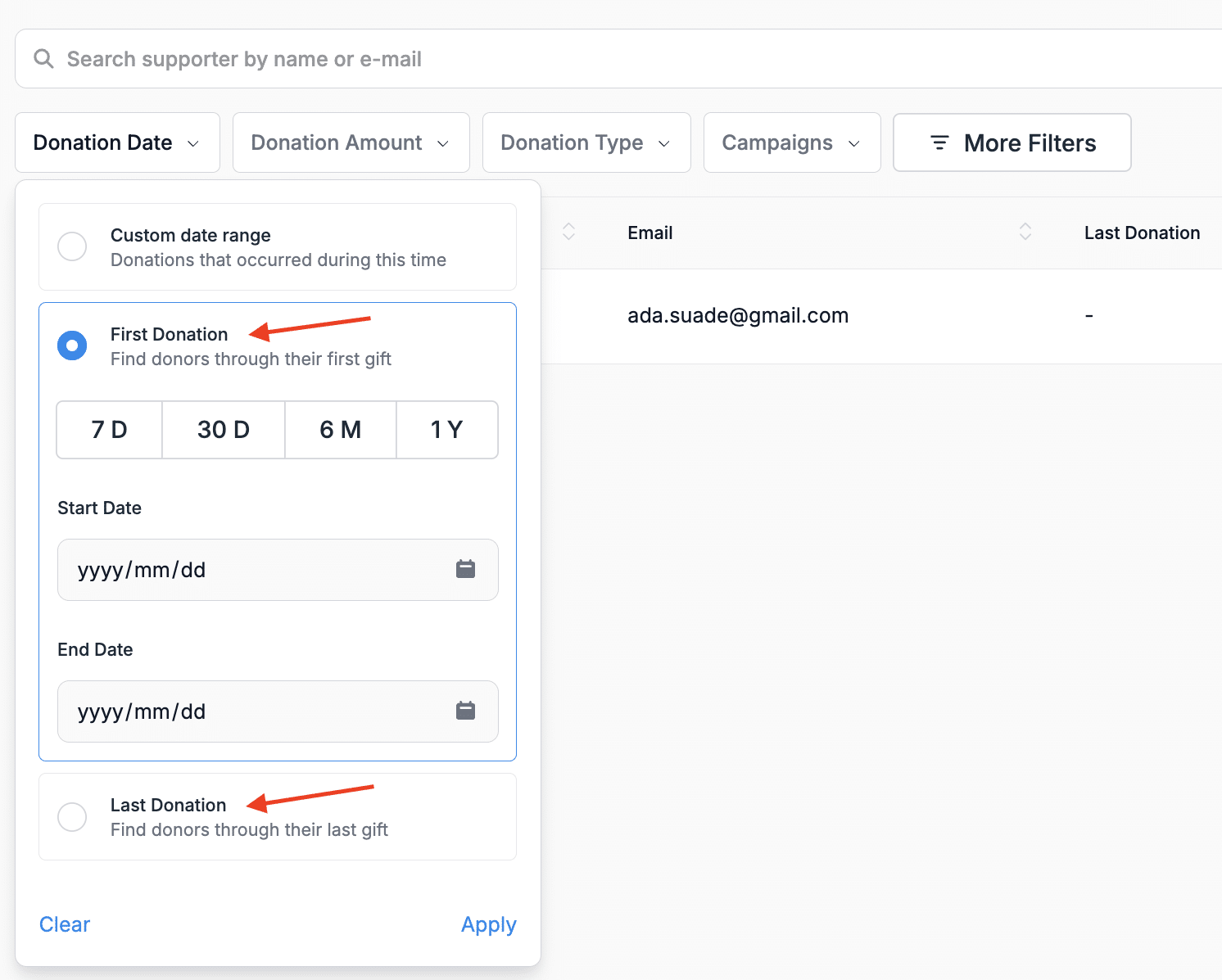
Use a donor management tool from a platform like Donorbox to apply advanced filters on donor records to segment your existing list of supporters.
Easily search for first-time donors or identify new donors for ongoing stewardship using the First Donation filter. And, use the Last Donation filter to identify supporters who haven’t donated in a while and launch win-back emails.
Plus, identify and re-engage lapsed donors by creating specific lists using the LYBUNT (Last Year But Unfortunately Not This Year) and SYBUNT (Some Year But Unfortunately Not This Year) filters.
These filters can be found under More Filters > Donation History on the Supporters page.
3. Scalable
A database that can grow and adapt to your needs is vital to your fundraising success. You should therefore be able to easily merge duplicate data and maintain a clean database.
Major donors provide sufficient funds to upgrade programs, run successful capital campaigns, and hold exciting events. This makes them essential for long-term fundraising success.
Nonprofit donor databases that offer ways to measure a donor’s giving potential and search for major donor prospects are a great way to secure more major donors.
To identify additional significant levels of giving potential – such as mid-level donors – divide your list of supporters. These supporters usually donate more than $1000 to an organization, but that amount may vary.
Identify a specific set of donors using filter options like minimum and maximum donation amounts. See how this works on Donorbox:
5. Adding and tracking communication notes
Your donor database should let you add any communication notes following outreach with donors.
This helps you track everything in one place and ensure optimal donor management and future campaign performance.
6. Integrations
Your donor database should integrate with other tools that streamline email and social media marketing, donor relationship management, creating reports, automating tasks, and beyond.
Add-on Functionalities
7. Online giving
Most nonprofit databases come with an online giving platform. Donation software that includes donor databases and fundraising features enables more successful fundraising.
Not all donor bases for nonprofits are built the same. As you begin researching your nonprofit’s database, determine what tools you already possess and which ones you’ll benefit from most in the future.
8. Email marketing
Personalized communication is vital for fundraising success.
Ensure your database incorporates email marketing tools that make it easier and faster to send highly targeted, mass email appeals, impact reports, and more to donor segments.
9. Volunteer database
If your nonprofit relies on volunteers to run programs or events, look for a database that makes tracking volunteer activities and hours simpler.
Volunteer management features included in your donor database help send time-sensitive updates, oversee volunteers’ progress, and send appreciation emails and cards.
10. Membership database
Memberships help grow focused support and strengthen donor retention.
A membership database helps you monitor members, get notified if they’ve changed their status, and receive reminders to send updates or thank yous when anniversaries and other crucial deadlines approach.
Platforms like Donorbox make it easy to manage your members from the donor database and locate event ticket purchasers. You should also be able to segment supporters based on membership tiers.
11. Matching gift database
Imagine being able to double every donation you receive. Thanks to the trend in corporate responsibility, many businesses offer a gift-matching option to their employees.
A matching gift database included in your donor database lets you find and track which donors and employers have this option.
Donorbox integrates with Double the Donation to offer you a donation-matching widget that can be added to your donation form. Donors can search for their company and see if their donation qualifies for a matching gift. Learn more about this integration below:
5 Best Nonprofit Donor Database Solutions
1. Donorbox Donor Management
Donorbox offers advanced fundraising features and donor management tools for nonprofits of all sizes.
Store and manage donor information and add communication notes. Plus, add offline donor and donation data, merge donors, and remove duplicate accounts.
Donorbox’s donor database provides advanced donor filters to segment donor profiles based on the time frame, location, donation amounts and frequency, campaign name, number of donations, and more.
Plus, create in-depth donor reports and export them to personalize your future communications. Donors can also log in to their own donor accounts, manage their donation plans and receipts, and repeat their gifts in one click using QuickDonate™.
Donorbox integrates with Salesforce, QuickBooks Online, Blackbaud Altru, and HubSpot to simplify your workflows and ensure accurate donor data records. Plus, connect with 5000+ apps like Google Sheets, Active Campaign, Airtable, and Slack via Zapier.
Nonprofits pay no start-up or monthly fees for Donorbox’s database and online donation tool. For the Standard plan, the platform fee starts at 2.95%, but you can upgrade to the Pro plan at $150/month and a platform fee of 1.75%.
This fee, along with the additional processing fee, can be covered by donors to ensure their full gift amount goes to the nonprofit.
2. Salesforce Nonprofit Cloud
Salesforce is well-known in the for-profit world for its quality and secure customer relationship management (CRM). Its Nonprofit Cloud offers the same services and streamlines fundraising, program management, grant management, and marketing.
Create customized dashboards for donors, businesses, grantees, and volunteers. All team members can view these dashboards; any relationship added automatically becomes a new donor profile.
Salesforce stands out from other databases because it enables you to add social media information and track online donor responses.
Salesforce’s Nonprofit Cloud starts at $60 a month per user. There is a 30-day free trial, but if that isn’t affordable, their Power of Us Program also includes 10 free Sales and Service Cloud Enterprise Edition subscriptions for all eligible 501c3 organizations.
Donorbox integrates with Salesforce NPSP to ensure you can easily send donor and donation data to your Salesforce account and manage them more effectively for elevating nonprofit growth.
3. Blackbaud Raiser’s Edge NXT
Blackbaud Raiser’s Edge NXT is developed explicitly for mid-sized to larger nonprofit organizations. The primary features of this database include the following:
Ability to track key fundraising metrics.
Donor cultivation tools.
Suggested ask amounts.
Identifying major prospects.
Raiser’s Edge also has a mobile app so nonprofits can access donor information from anywhere. This tool comes in handy when visiting major donors and collecting vital data.
If you’re interested in learning more and receiving a quote, visit their website.
If you’re using Donorbox for fundraising and donor management, you can easily activate the integration with Blackbaud RE NXT to sync all your donations and donor data in real-time.
4. DonorPerfect
Some nonprofits need more from their database than others. DonorPerfect is an excellent option for organizations with complex needs.
Features include:
Cross-referencing for all donor records to find relationships.
Different levels of access are available for team members.
Custom reporting and dashboards.
Integrated online donation and event forms.
Pricing is not publicly disclosed, so contact their team to learn more.
5. DonorDock
DonorDock is an affordable nonprofit database option with a few unique features. Like other nonprofit databases, DonorDock helps you track past giving, appeals, calls, tickets, emails, thank yous, and mailings.
Plus, segment and filter data to send personalized appeals and create reports.
What stands out is DonorDock’s action board, which sends reminders of donor milestones and daily suggestions on which donors they should connect with. This feature makes donor communication more manageable and lets you update and assign tasks to team members.
Another stand-out feature is the ability to track grant requests, store grant documents, and track relationships with foundations.
DonorDock is priced at $500 a month and includes unlimited contact records and up to five users. and include most features for one user.
Final Thoughts
A quality nonprofit donor database is essential for tracking donations, monitoring volunteers and members, and connecting donors with corporations, grant foundations, and other donors.
Donorbox offers advanced donor management tools and fundraising features designed to help you fundraise smarter and strengthen donor relationships.
Sign up for free today.
For more donor management and fundraising insights, check out the Nonprofit Blog. Subscribe to the monthly newsletter to receive a handpicked selection of exclusive resources in your inbox.
FAQs About Nonprofit Donor Databases
1. What is a donor database?
A donor database is software that nonprofits use to securely track and manage donor and donation data, segment the data, pull reports, and monitor other key performance indicators.
2. What information can I store in a nonprofit donor database?
The best donor database for nonprofits collects donor biographical and demographic information, interests, and connections with other donors and organizations. It must also store the donation data of each donor and offer the ability to add offline data.
Kristine Ensor is a freelance writer with over a decade of experience working with local and international nonprofits. As a nonprofit professional she has specialized in fundraising, marketing, event planning, volunteer management, and board development.

 Join the fundraising movement!