What Features Should Your Fundraising Platform Have?
Before you compare tools, it helps to know which features will actually move the needle for your nonprofit. Here’s what to look for.
Updated on

Before you compare tools, it helps to know which features will actually move the needle for your nonprofit. Here’s what to look for.
 Join the fundraising movement! Join the fundraising movement!
Picking a fundraising platform shouldn’t feel like a gamble.
But with countless tools all promising increased donations, powerful analytics, and superior support, it’s easy to become overwhelmed – or worse, locked into a tool that doesn’t serve your organization’s real needs.
Below, I look into the essential features every modern, empowering fundraising platform should offer, the questions worth asking before you commit, and common mistakes nonprofits make along the way.
Before you open a single fundraising platform comparison page, zoom in on your own organization.
The biggest risk in any fundraising software evaluation is skipping this step and jumping straight to feature lists, only to discover months later that the platform you chose doesn’t really match your needs.
Here’s what to assess before you start shopping.
Are you focused on growing recurring giving? Improving donor retention? Running a major campaign successfully?
Your answer shapes everything. So, define the results you want from your platform before you start comparing options.
Take a look at your calendar and think through the fundraising campaigns you plan to run across the year. For example, your nonprofit may rely on:
Not every platform handles all of these well – and switching tools every time you run a different campaign type creates unnecessary complexity.
If you’re switching from an existing tool, this question is gold.
Be honest and specific. Is the donation form experience clunky? Are you struggling with poor reporting? Weak integrations?
A powerful platform is only valuable if your team can actually use it.
Factor in technical confidence, staff bandwidth, and how much ongoing configuration you can sustain. The best platform for your organization is the one your team will actually use well – no complexity, advanced but easy to use.
Bonus resource: For a structured way to work through this process, our guide to conducting a nonprofit technology audit walks you through assessing your current tools and identifying gaps.
Once you know what your organization needs, here’s what to look for when you evaluate your options.
Bear in mind that these are the features that separate an effective platform from one that will frustrate you six months down the line.
Your donation form is where donor intent becomes revenue – and a clunky, slow, or confusing form will cost you gifts.
The ideal platform offers forms that load quickly, display beautifully on mobile, support multiple giving frequencies, and reduce friction at every step.
Bonus points if that platform offers embeddable forms that blend seamlessly into your website.
Look for advanced customization options, too, including the ability to match your organization’s look with colors, fonts, and imagery. This means every touchpoint reinforces your brand identity and builds donor trust from the first click.
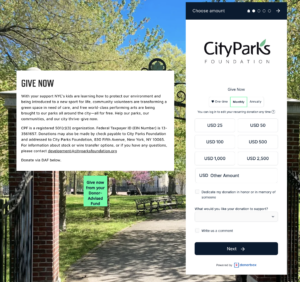
A branded, consistent donation experience is one of the most direct ways to earn that trust. The Donorbox OmniGive™ Donation Form, for example, is designed specifically to reduce drop-off and keep donors trusting and engaged from start to finish.
See how City Parks Foundation uses OmniGive’s advanced customization capabilities to create a fully branded, embedded donation experience that builds trust and keeps supporters engaged.
Your fundraising doesn’t happen through a single channel, so your platform shouldn’t be limited to one either.
Look for a platform that supports recurring donations, peer-to-peer fundraising, crowdfunding, in-person giving, event ticketing, and in-honor giving, all in one place.
The fewer software providers, logins, and data migrations you have to deal with, the better!
Acquiring a donor is expensive. In fact, raising $1 from a new donor can cost up to $1.50, while raising the same amount from an existing donor costs only around $0.20.
Retaining supporters is where the real return lives. Your platform should empower you to track donor history, segment your donor base, and personalize your communications, not just process transactions.
Features like automated thank-you emails, donor portals, and detailed giving histories are the foundation of effective donor stewardship.
You can’t improve what you can’t measure.
When comparing platforms, look for reporting dashboards that make your key metrics clear at a glance. You should be able to understand exactly what’s happening – without the help of a data analyst.
Check for easy-to-read insights like:
No fundraising platform is an island. Your donation tool needs to communicate with your CRM, your email marketing system, and your accounting software.
According to a 2024 survey by Global Growth Insights, 64% of nonprofits rely on donor CRM platforms. But even when organizations do have a core system in place, they often still use separate tools for other tasks – and those tools don’t always integrate well.
Before committing, check which integrations are native versus available. Connections with Blackbaud Altru, QuickBooks, Zapier, and Google Analytics are a good baseline to check. Strong native email marketing capabilities, in particular, can significantly improve how you nurture and retain donors over time.
Donors trust you with their financial information, so honor that trust.
Choose a platform that’s PCI-compliant and supports the payment methods your donors actually use, like:
Bonus resource: Take a look at our detailed nonprofit payment methods guide to see which methods donors prefer using today.
The platform that serves you at 500 donors needs to still serve you at 50,000.
Ask whether the platform can grow with your donor base, not just serve your current needs. The ideal tool should have a strong track record with organizations your size – and larger.
Before you book a demo (or spend an hour sitting through one), run through this short list. The answers will tell you quickly whether a platform is worth your time.
Even well-resourced teams fall into these traps. Knowing them in advance will save you time, money, and frustration.
Free or very low-cost platforms are appealing, especially for smaller organizations watching every dollar.
But “zero-fee” claims almost always come with trade-offs: higher transaction fees buried in the fine print, limited features that require expensive add-ons, or a poor donor experience that quietly costs you in conversion and retention.
As we explore in our blog, “Why Smart Nonprofits Invest in Better Software”, the real cost of a platform isn’t its monthly price. It’s what it costs you in staff time, missed donations, and donor drop-off when it underperforms.
A fundraising platform that isn’t in sync with your CRM or email marketing tool will create work and consume time, not save it.
Staff end up manually exporting and importing data, reconciling duplicates, and losing the connected view of their donors that makes good stewardship possible.
Before signing up, map out every system your new platform needs to talk to, and verify that those integrations are live, maintained, and can be included in your plan tier.
It’s easy to evaluate platforms from the admin side – dashboards, reporting, campaign tools – and forget to consider how the experience looks and feels to a donor.
Test the donation flow yourself. How many steps does it take? Does it work on mobile? Does it look like it belongs on your website?
A form that erodes donor confidence, even slightly, is costing you money with every visit.
Choosing a fundraising platform is a significant decision, but it doesn’t have to be a painful one. Make sure to:
When you work through this checklist honestly, the right platform becomes obvious – not because of its marketing, but because of how well it fits your team, your campaigns, and your donors.
Speaking of fit, Donorbox is built to check all the boxes on this list: advanced customization, dozens of popular payment methods, conversion-optimized donation forms, multiple campaign types, built-in CRM with email marketing, robust integrations, enterprise-grade security, and more.
Check out the features that make Donorbox the trusted choice for 100,000+ organizations who’ve raised $4 billion, and counting.

Dr. Noel Jacob has spent her career leading marketing and business growth across a variety of industries. At Donorbox, she led Product Marketing and now spearheads Content Marketing, equipping nonprofits with practical insights, fundraising best practices, and educational content that help them make the most of powerful fundraising products and features.
As a leader in a Christian nonprofit organization and an active member of her local nonprofit community, she understands the realities nonprofits face and loves sharing strategies that help them strengthen their fundraising and amplify their impact.
 Join the fundraising movement! Join the fundraising movement!