6 Signs Your Nonprofit CRM Is Too Complex for Your Needs
Starting to doubt your CRM? You’re not alone. Here are the signs that your tools are more than you need.
Updated on

Starting to doubt your CRM? You’re not alone. Here are the signs that your tools are more than you need.
 Join the fundraising movement! Join the fundraising movement!
On my first day working for a nonprofit, I was introduced to everyone in the building, given a general overview of operations, and then handed a book the size of a brick.
It was the manual for their CRM.
Thankfully, I wasn’t expected to read the whole thing. But I learned an important lesson about nonprofit software that day: a lot of it is needlessly complicated for your day-to-day tasks.
If you’re wondering whether your nonprofit CRM might have more bells and whistles than you (or anyone) need, here are the signs to look out for.
You might be thinking, so what if my CRM has more complexity than I need? Maybe you think your organization will grow into it someday, so it’s worth starting now.
A CRM that is too complex can cost you:
Not sure if your CRM is too complicated for your needs? Here’s how to tell.
If you’re in your CRM every day and still don’t feel like an expert, chances are you have more features than you need.
Maybe you have to consult a massive manual just to figure out how to pull the list you need. Or online training materials that don’t show the exact workflow you need, and thus feel useless.
If your CRM feels impossible to master, chances are it’s not the right fit.
Does a simple task take longer because you have to customize your CRM to get the job done?
Many CRMs on the market, especially open-source CRMs, advertise a “customizable” experience designed to make your CRM match your needs. This is a perk for larger organizations that want to create custom workflows and unique post-giving experiences for donors.
But this type of customization can also lead to frustration, dead ends, and negative donor experiences.
You may need to look for a new CRM if the one you have isn’t functional without significant customization.
Is manual entry the name of the game with your CRM? Hours of admin and data maintenance eat up your day, leaving you no time for donor outreach that will move the needle.
Ideally, you should be able to quickly pull and sort the information you need. Adding to a donor record should take just a few seconds – and only a few clicks.
If your CRM doesn’t offer helpful automation and common-sense data flows, you might be using the wrong tool.
You know you’ve launched a campaign. But you have no idea how to begin to measure its outcomes.
Your CRM should make reporting easy, so you never have to guess about your campaign effectiveness. Robust reporting leads to better campaigns and more funding for your mission.
It’s time for a CRM that makes reporting easy, comprehensive, and intuitive.
We’ve all seen those donor profiles with a million random notes, no clear timelines, and incorrect information.
No one needs an additional level of uncertainty when preparing for a donor meeting. Your CRM should offer clear, easy-to-understand donor profiles that show a clear timeline of interactions.
If you’re lost in years of data entry and unclear donor profiles, look for a CRM that offers crystal-clear relationship management.
Ah, the dreaded CRM-native donation form. We’ve all seen them. They were designed over a decade ago and overwhelm donors with too many fields and too much information.
While built-in fundraising tools are very convenient, if you plan to use them, you need to choose a CRM with effective tools.
Look for a platform with customizable donation forms, easy-launch campaigns, event ticketing, and more, so everything can truly be in one place.
Your CRM should be a great fundraising partner – not a challenge you must overcome with every campaign.
So, how did we all get here?
Here’s what happened and how to avoid it on your next software search.
Your board members or other high-level decision makers typically aren’t the ones in your CRM every day, pulling lists and sending communications.
They might have an idea of what that work is like and what you need to accomplish, but they don’t know what it’s like to be in your shoes today. This can lead them to choose software that isn’t user-friendly or doesn’t provide the functionality you desperately need to do your job well.
That’s why it’s your job to educate them.
Review any CRMs being considered and share your feedback. Show decision makers why some software may be too complex – even if it sounds great on paper.
Some CRMs come with contracts designed to keep you stuck in clunky systems for years to come.
For example, you might have a contract to use the software for the next two years, but a separate contract to access the software training that lasts three years. These types of contracts are designed to incentivize you to stay for another two years, and another two years, until you feel like you can’t get out.
Be wary of predatory contracts. Instead, look for flexible contracts with clear terms, and avoid separate training or support contracts.
CRMs like Donorbox CRM come with free training materials that everyone in your team can easily access online. No more brick training manuals!
Maybe the decision makers in your organization want to go with a complex CRM because they’ve heard about it and know that many other organizations are using it. If others are using it, it must be good, right?
This logic is flawed for a couple of reasons. Sure, if a CRM is serving many different organizations, that’s great! But it could be a popular choice for the same reasons listed above – uneducated decision-makers and predatory contracts.
Additionally, there’s no one-size-fits-all approach to a CRM. What works for a human rights organization might not serve a museum.
Create a list of your must-haves. Get as specific as possible to help you block out the everyone-is-doing-it noise. If you need some inspiration, here’s my list of eight things to look for in a CRM.
What does your organization need for day-to-day stewardship and donor management?
Download our free guide to choose the best CRM for your nonprofit. We’ll cover seven best practices so you can make the right choice for you.
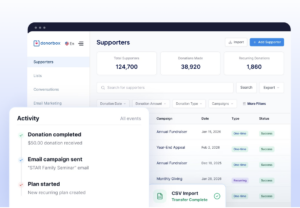
At Donorbox, we build tools designed for the actual day-to-day lives of fundraisers. Donorbox CRM offers robust functionality without the complexity, enabling you to get more done and build better relationships. Without studying the manual.
Donorbox CRM offers:
Plus, it comes with Donorbox’s industry-leading fundraising features, including fully customizable donation forms, event ticketing, one-click repeat giving, recurring donation features, and more.
No matter which CRM you end up using, look for one that fits your needs now while still leaving a little room to grow. Your tools should never hold you back or waste resources, so making the best choice now will serve you better in the long run.

Lindsey Bower is a writer, content strategist, and nonprofit consultant. She specializes in helping nonprofits craft compelling messaging for websites, blogs, social media, and email marketing, with a strong focus on SEO and AEO strategy. With a background in fundraising and membership management, she knows firsthand what it's like to juggle priorities and wear many hats in the fast-paced nonprofit world.

 Join the fundraising movement! Join the fundraising movement!