Agentic Giving: Is Your Nonprofit Ready for AI-Powered Donations?
Agentic giving could change how donors find and support your nonprofit. Learn how it works and what you can do to prepare.
Published on

Agentic giving could change how donors find and support your nonprofit. Learn how it works and what you can do to prepare.
 Join the fundraising movement! Join the fundraising movement!
 Add us as a preferred source on Google
Agentic giving is an emerging form of charitable giving where a donor asks an autonomous AI agent to find a nonprofit or campaign and, in some cases, make a donation on their behalf.
While agentic giving is still emerging, how donors discover and support nonprofits is already changing.
A recent study revealed that 4.5% of 1,728 surveyed donors use AI to find and research causes to support. While that number may seem small, it highlights a change in the way donors are finding nonprofits like yours.
Preparing for this shift in giving behavior now can help your organization become more discoverable to AI tools and better positioned to capture more generosity in the future.
Agentic giving refers to when a donor authorizes an autonomous AI agent to identify a charitable organization or initiative, make a recommendation, and donate on their behalf.
For example, a donor might prompt their AI agent with the following:
Show me a list of well-known nonprofits in my community addressing food insecurity.
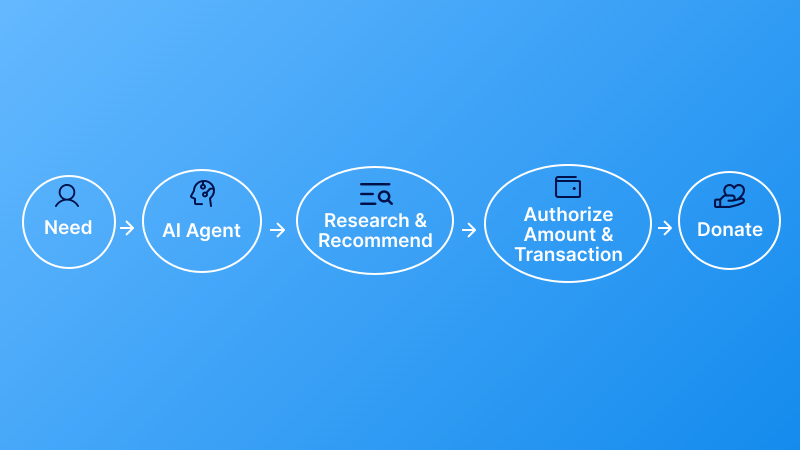
The AI agent will then provide a list of recommended options. Once a donor selects a campaign to donate to, chooses a donation amount, and authorizes the transaction, the AI agent completes the donation for them and shares a donation receipt.
Where generative AI tools like ChatGPT may influence who a donor gives to, AI agents help them complete the action.
While the donor remains in charge of whether to donate or not, the AI agent recommends which organization they should give to.
The table below breaks down the key differences between generative AI and AI agents based on donor usage:
| Generative AI | AI Agent |
|---|---|
| Generates, summarizes, and explains information | Takes actions toward a specific objective |
| Helps donors research and compare nonprofits and their specific causes (e.g., nonprofits supporting clean-water initiatives) | Can research, recommend, and facilitate an authorized donation based on a prompt |
| Tends to guide the conversation | Sets the goal and authorizes relevant actions after being prompted |
| Supports donor research and decision-making | Can eventually support the full donor journey (from research to completing a donation) |
AI is already changing the way donors search online. Zero-click search, chatbot queries, and AI summaries are replacing traditional search for many donors.
Donors who find your donation page through AI tend to be highly engaged and more likely to give. AI visitors stay more than 70% longer on nonprofit websites than other visitors, including organic search visitors.
A recent study showed that 43% of donors say AI would have a positive or neutral impact on their giving behavior, with 14% saying they’d be more likely to give.

While AI isn’t replacing the conventional donor journey right now, agentic giving could eventually bridge the gap between the discovery phase and the act of giving itself.
Let’s look at how agentic giving can alter the donor journey.
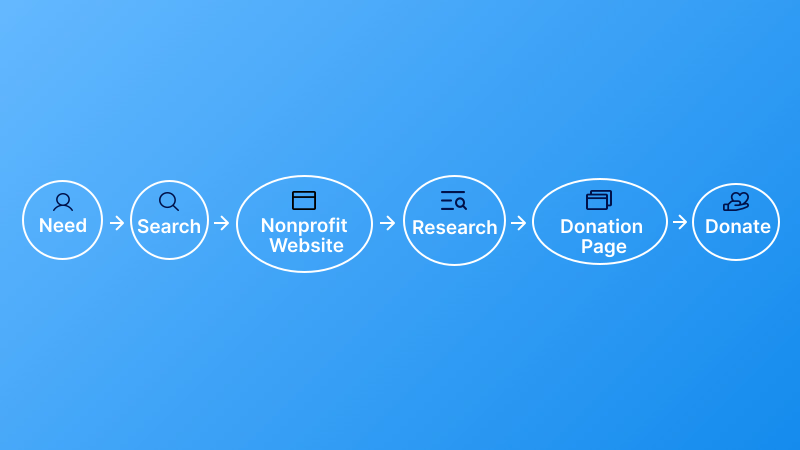
Traditionally, donors interested in a specific cause search online to find organizations whose missions align with their interests.
They’d then navigate to relevant nonprofit websites that appear in search engine results to research further to decide whether or not to support a specific cause.
The traditional donor journey looks something like this:
Agentic giving has the potential to revolutionize the entire donor journey. It would essentially remove the need for donors to manually research and narrow down a list of causes to give to – and help them complete a donation.
The new donor journey with agentic giving could look something like this:
But before an AI agent can recommend your nonprofit to a donor, it first needs to find your website.
The latest M+R Benchmarks report revealed that organic search traffic to nonprofit websites fell from 43% in January 2025 to 26% in December. This can be largely attributed to zero-click search behavior, as I mentioned earlier.

If your organization isn’t showing up in AI results, you may be left out of the conversation and miss out on donations.
Not sure whether your nonprofit website ticks all the necessary boxes? Download this free AI visibility checklist to increase your online visibility so you’re found by the people actively looking to give:

While agentic donations have not yet replaced traditional giving methods, it’s important to start preparing now so your nonprofit is discoverable when it becomes the norm.
Use these three steps to ensure you’re discoverable by AI-referred donors:
Now, let’s look at what’s required in order for agentic giving to be successful.
Agentic giving starts with understanding the purpose of your donor’s goal. Donors must first provide a prompt explaining what type of cause they’re looking to support.
For example, a donor might instruct their AI agent to do the following:
Give me a list of local nonprofits who focus on providing children with learning materials for school.
Once the AI agent understands what a donor wants, it will then look for a specific cause or initiative that aligns with the donor’s intent.
If your nonprofit’s website uses broad language such as “creating a better future for children,” the AI agent may have difficulty determining what you do.
Provide clear descriptions of your mission, impact, and programs so the AI agent can comprehend whether your organization is relevant based on the donor’s intent.
Make sure the information about your organization clearly communicates:
This improves your chances of being included in the list of campaigns the AI agent recommends to a donor.
Once a donor confirms which cause they’d like to support, the AI agent will ask them to confirm a donation amount from a list of suggested options displayed.
The donor must make the final decision and authorize the transaction themselves. For example, they may need to click on a push notification to confirm a donation via the relevant payment method (e.g., a digital wallet).
Once the transaction is completed, the AI agent should provide the donor with a receipt.
The donation receipt may include information such as:
As a nonprofit, you still need a complete record of all donations you receive. This supports your donor stewardship and tax filing efforts.
It’s crucial that AI agents can integrate with your fundraising and donor management software, so you have access to complete donor profiles and donation records.
While agentic giving is still a novel concept, it has the potential to uproot traditional giving behavior. With AI already changing the way donors discover nonprofits like yours, preparing now can set your organization apart and increase your AI visibility in the future.
A strong online fundraising setup matters here, too. Donorbox is a unified, global fundraising platform that offers powerful yet intuitive online and in-person fundraising features to take your fundraising to the next level.
For more fundraising insights and ideas, visit the Nonprofit Blog. Subscribe to the monthly newsletter to receive the best resources in your inbox.
Agentic donations are charitable contributions facilitated by an autonomous AI agent. The AI agent can research and recommend causes to donate to based on a donor’s preferences and complete a gift once a donor gives authorization.
Agentic giving is still an emerging concept and has not yet replaced traditional giving methods. However, as more donors turn to AI tools to find nonprofits, agentic giving could eventually connect the discovery phase to the act of giving.
Zero-click search and chatbot queries are replacing traditional online search behavior. Ensuring your nonprofit website is credible and easy for AI tools to find and understand will strengthen your ability to capture more donations from donors who use AI to search for causes.


Jamy-Lee has over 7 years of experience in copywriting and content marketing. With experience teaching in underserved communities and volunteering for animal rescue organizations, she has a first-hand understanding of the challenges faced by mission-driven organizations. She now uses her passion for writing to share practical insights that help nonprofits fulfill their missions.
 Join the fundraising movement! Join the fundraising movement!