Why Your Nonprofit Website Traffic Is Dropping – And What to Do About It
Nonprofit website traffic is declining, but your important cause still needs to be found. Here’s how to adapt as search keeps changing.
Updated on

Nonprofit website traffic is declining, but your important cause still needs to be found. Here’s how to adapt as search keeps changing.
 Join the fundraising movement! Join the fundraising movement!
Noticing a drop in your nonprofit website’s traffic? You’re certainly not alone.
M+R Benchmarks latest report shows that nonprofit organic traffic volume fell from 43% in January 2025 to 26% in December.
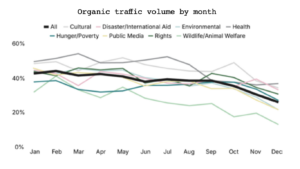
Courtesy of M+R Benchmarks, 2026.
The bigger concern is what’s causing the drop. AI Overviews, zero-click results, and chatbot searches mean supporters are now learning about your cause without ever landing on your website.
That’s a problem when your site is where people understand your work and decide whether they trust you enough to give or take action.
In this blog, I’ll explain why traffic is dropping, how search has changed, and how to keep your nonprofit site visible.
Organic traffic has been hit by a few overlapping changes, but most of them come back to the same issue: people don’t need to click as often to get an answer.
Why is that?
Remember when you first noticed that long AI-generated summary at the top of your Google search? Now think about the last time you actually scrolled past that to find your answer.
Google rolled out AI Overviews (AIOs) more widely in May 2024, giving searchers summarized answers at the top of the results page. When displayed, AI Overviews result in a -46% drop in click-through rate (CTR) and 69% of zero-click searches.
For charities, this is especially relevant because so much of nonprofit content is educational. A search like “which nonprofits help animals in the US” now returns an AI-generated answer before the user reaches any nonprofit website.
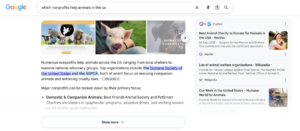
That’s a big shift! Someone who may have once clicked through to read impact stories or find a donation page might now get a quick summary and stop there.
Search behavior changes aren’t limited to Google, either.
More and more people are turning to tools like ChatGPT, Gemini, Claude, and Perplexity to ask detailed questions and get hyper-specific answers. Now, 37% of consumers start searching with AI instead of Google.
These searches also tend to sound different from traditional Google searches. The average length of a ChatGPT prompt is 23 words vs. 3-4 words on Google search, highlighting the rise in longer, more conversational search queries.
Instead of typing something short into Google’s search bar like “animal charities USA,” someone might ask ChatGPT, “Which animal nonprofits in the US should I donate to?”
The whole search journey changes. The user may get a full response inside the chatbot, with no need to open a results page at all. Here’s an example of what you’d get in response:
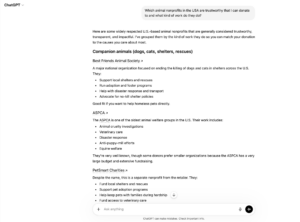
For nonprofits like yours, this may create a new visibility problem. Yes, your organization might be mentioned and summarized, but it could also be left out completely – all depending on what the specific AI search tool understands about your work.
And when the answer happens away from your website, potential supporters will miss a lot (if not all) of the campaign messaging, imagery, and donation prompts your team carefully curated to help them take the next step.
For a long time, search industry experts enjoyed a relatively straightforward goal: rank well, get more traffic.
That relationship is less reliable now. Your nonprofit website or blog may still appear on page one, but if the search results include an AIO, the traditional organic links are no longer getting the same attention.
This is why a traffic drop doesn’t always mean your content suddenly becomes less helpful. Your page might still be visible. It might still be ranking. But the search results page has changed around it.
Lower organic traffic can mean fewer chances to bring people into your world.
Someone who lands on your website can do more than read an answer. They can:
Of course, I’m not suggesting that every traffic drop will lead to an instant drop in donations. But fewer visits can reduce the number of opportunities your nonprofit has to turn interest into support – especially if your educational content has historically helped people discover your work.
M+R Benchmarks data gives that concern some weight:
Nonprofits received donations from 1.6% of website visitors, generating an average of $1.33 per visitor.
So, when organic traffic drops, your visibility isn’t the only thing at risk… it’s fewer moments where someone can take the next step.
Now you know why your traffic may be dropping. What can you do about it?
You obviously can’t control every AI summary, chatbot answer, or Google update (though marketing professionals worldwide have tried in vain). But you can influence how easy your organization is to find, understand, and trust.
In other words, your strategy needs to go beyond traditional search engine optimization (SEO). You still need strong website content, but you also need to think about brand visibility and what happens when someone finally does land on your site.
Here’s where to start.
AI tools are pulling answers from across the web. Therefore, your website can’t be the only place where your nonprofit’s work is clear and credible.
This is where AEO comes in. AEO, or answer engine optimization, refers to the process of helping AI-powered search tools understand and mention your organization accurately. Of course, your website plays a huge role, but so do trusted third-party sources.
Starting your AEO efforts might mean:
It may seem like a lot… but your main goal should just be consistency. If your mission, programs, and impact are described clearly and often across trusted sources, AI tools have a better chance of connecting your organization to relevant cause-related searches – and ultimately the right donors.
Still unsure? Download our free AI visibility checklist to start off on the right foot:
Like I said above, your off-site presence is super important, but your website is still one of the strongest signals you can control.
When traffic starts dropping, it’s easy to panic and jump straight into creating new content or launching an altogether new content strategy. However, your best opportunities are often already on your site!
Start by looking at the pages that:
These may include educational blogs, campaign pages, volunteer pages, or resources that answer common questions about your cause.
Once you’ve identified some promising options, update what needs attention – with both people and AI-powered search in mind. Replace outdated stats or facts. Tighten unclear sections. Add relevant internal links. Your goal is to make these pages current and easy to understand and cite.
AI is a pro at summarizing general information. In other words, “what is” and “how to” content may have a harder time earning clicks now than it used to.
For your organization’s site and/or blog to stand out, you have to offer something people can’t get from a quick AI summary.
That could include:
Of course, that doesn’t mean every piece of content needs to become a research report. Rather, your content should reflect what your nonprofit knows (better than anyone else) from doing the work.
That lived experience is invaluable – it makes your content more useful for readers, more credible to search engines, and (happily) more difficult for AI tools to cram into a generic summary.
Despite all the recent upheaval, search still matters. It shouldn’t be the only way people find their way to your nonprofit, though.
As AI summaries and AI-powered search continue to reduce clicks, you should place a bit more focus on owned and direct channels. These are the all-important places where you can speak directly to supporters without waiting for Google to send them your way.
Focus on channels that will help you keep the relationship going, like:
This should help you protect your nonprofit from experiencing the often detrimental effects of sudden search changes. Plus, it also gives people more chances to remember your name.
Important as they are, organic sessions no longer tell the whole story. Search has changed dramatically these past two years, and your reporting needs to change with it.
A drop in traffic looks scary on its own, but it means more when you compare it with visibility, engagement, and conversions.
Be sure to look at metrics like:
Measuring all or most of the above gives you a clearer view of what’s actually happening. Yes, your organic traffic may be lower, but if the right people are still finding you and taking action, then your strategy is still doing what it should be.
If organic traffic continues to decline, every visitor becomes that much more valuable. Make the most out of those visits by providing a giving experience that’s trustworthy and easy to complete.
Start by checking if your donation page or form is conversion-friendly. Ask yourself:
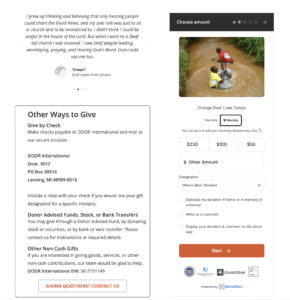
As a good example, check out how Door International uses Donorbox to offer an attractive and conversion-optimized giving experience:
Traditional search may be sending fewer people to your website, but the need behind those searches hasn’t really changed. People are still looking for causes like yours to trust and support.
Your job is to make sure your nonprofit can still be found and understood using the methods I discussed above – even when the path to your website is less direct.
And when supporters do reach your website, make sure that giving is simple. Platforms like Donorbox empower you to easily create branded donation forms, sell tickets to events, and more, so you can turn interest into lasting support.

Fern is a journalist-turned-editor with 8 years of writing experience, now using that skill set to help nonprofits share their stories and connect with donors. Along with her editorial work, Fern volunteers with animal welfare organizations and has spent years fostering and rehabilitating rescue parrots.
 Join the fundraising movement! Join the fundraising movement!