Tackling the Nonprofit Development Staffing Dilemma
Which comes first – raising more funds or building the team you need for sustainable growth?
Published on

Which comes first – raising more funds or building the team you need for sustainable growth?
 Join the fundraising movement! Join the fundraising movement!
Nonprofits and the professionals who lead and raise funds on their behalf are under constant pressure to hit ever-higher goals.
Conventional wisdom leads most organizations to address the gap by launching yet another new campaign or donor acquisition strategy, squeezing just a little more effort out of an already overburdened staff. It’s no wonder that burnout is so prevalent in the industry.
In this blog, I’ll explore why “more effort” or “more staff” alone won’t solve the development staffing dilemma, and how the right mix of people, skills, and systems creates a more sustainable path forward.
In the State of Nonprofits 2025 report, the Center for Effective Philanthropy reports that nearly 90% of more than 200 nonprofit leaders surveyed expressed concern about their own burnout, with a similar number worried about the impact of burnout on their staff.
Some will consider “staffing up” to take on some of the workload, yet according to the same survey, nearly two-thirds were “reporting difficulty filling vacancies and more than half noting insufficient funding to recruit, retain, and support their staff.”
The bottom line? Neither approach is a home run to sustainability.
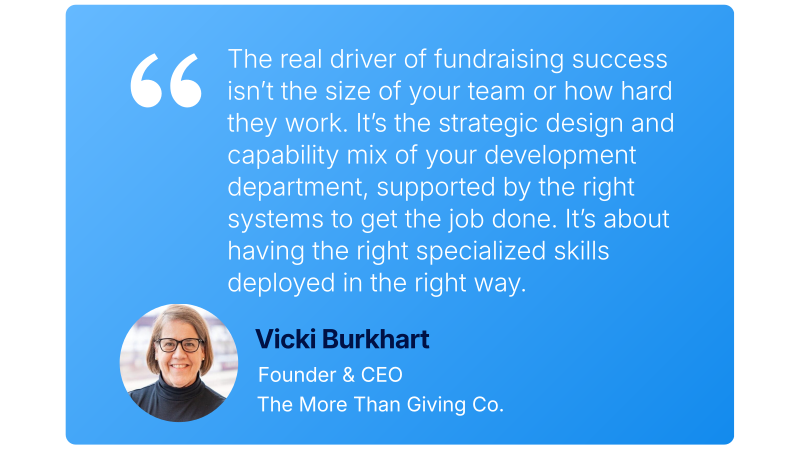
What a conundrum. You can’t grow your development staff without growing your funding base, but you absolutely cannot cultivate long-term donor relationships without the right people and systems in place.
You need the right fundraising software, a compelling case, and a promising field of prospective donors, and skilled team members who can segment your audience, cultivate major gifts, and manage stewardship.
Staffing + technology = a successful, resilient fundraising program.
We are all too familiar with the nonprofit starvation cycle and its connection to the unicorn approach to hiring.
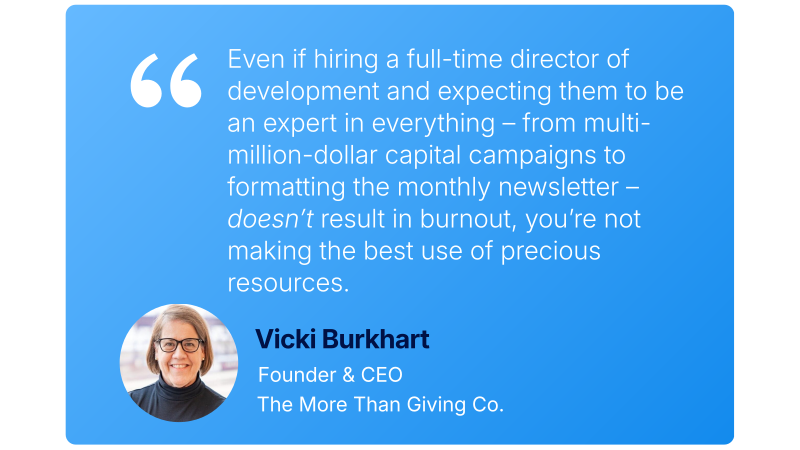
Retain one director-level person to do all of this, and you will end up overpaying for administrative work or under-resourcing the work that needs to be done by a seasoned development professional with the expertise to close major gifts.
Before placing that “Unicorn Wanted” job ad, take a step back and consider the Three C’s: culture, capabilities, and capacity.
The Three C’s make it possible to focus on deliverables rather than job descriptions. Combine your skills map with a fractional staffing approach, and you will get a team that actually fits the bill – in terms of cost as well as expertise.
For example, More Than Giving’s clients use fractional team building to create precise staffing solutions:
Regularly reviewing with the Three C’s in mind allows you to adjust and stay current with the needs of your growing fundraising program. A fractional team’s time commitments can be adjusted quickly, and members added or removed seamlessly – without the cost or time commitment of typical hiring processes.
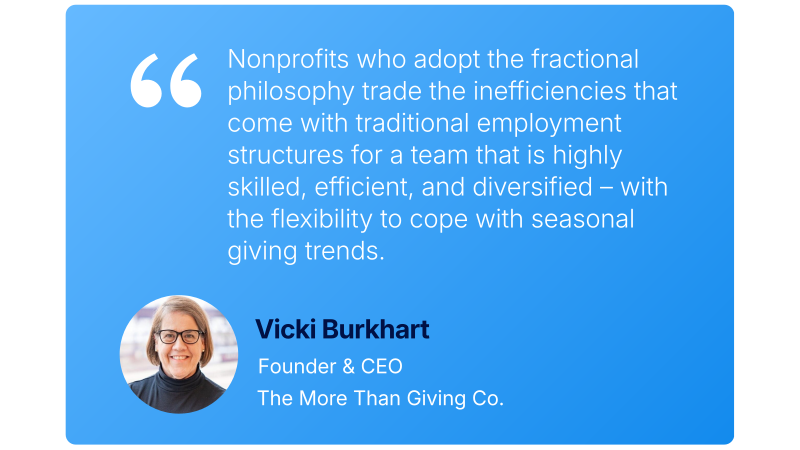
And although it may sound counterintuitive, the fractional team’s ability to ride the waves of the fundraising cycle creates stability, which in turn supports long-term donor relationships.
A fundraising skills audit is an opportunity to take a hard look at your organization’s fundraising potential against what resources you have, both human and financial, and what you will need to mine that potential.
List the exact capabilities needed to hit your fundraising goals in the next 12 months and assign a bandwidth to each. To avoid bias and blinders, consider engaging an outside fundraising expert to bring in fresh insights and perspective.
Fractional fundraising support doesn’t replace the role of the executive director (or even the role of an in-house development director or major gifts officer) in donor relations; it acts as a force multiplier, freeing them from administrative tasks so they can get to the real work of high-level donor cultivation and solicitation.
Fractional development professionals are not disconnected vendors.
Engage them as team members so you can get the most from their expertise, their role as hands-on participants, and therefore, your investment.
The right people can only do their best work when the right systems are in place.
Before adding more fundraising capacity, take an honest look at the tools and processes your team relies on for their day-to-day tasks.
A technology audit goes a long way toward helping you spot what’s working and what’s slowing your team down.
At More Than Giving, we run independent, nonprofit-specific tech audits to bring your development operations up to speed, empowering you with the tools to move forward with confidence.
Plus, More Than Giving’s partnerships with top-notch providers like Donorbox connect you to the right platforms for your needs.
The reality of fundraising today makes it more imperative than ever for nonprofit leaders to access every available resource – expertise, skills, structure and roles, people power, and tech.
When you have the right ones in place, you have the recipe for successful, resilient, and sustainable fund development.
Stop chasing dollars and start building the foundation – and the meaningful donor relationships – that lead to true impact.


Vicki Burkhart is the founder and CEO of The More Than Giving Co., a nonprofit fractional
staffing firm providing nonprofits with affordable, on-demand staffing solutions to supplement
the bandwidth and skillsets of their current team. Our Nonprofit Systems Optimization (NPSO)
professionals possess the nonprofit technology expertise necessary to ensure that your
organization has the right technology, and the staff to operate it.

 Join the fundraising movement! Join the fundraising movement!