Unicorn Riot’s long legal battle in Minnesota to protect newsgathering materials from attorneys working for Energy Transfer reached yet another phase: The Minnesota Supreme Court released its ruling Wednesday about the subpoena in Hennepin County that has attempted to probe our organization. The court rejected Energy Transfer’s attempt to compel the release of newsgathering materials and reporter communications; it also ruled that a judge could order a complex document called a privilege log to be created. [Article on UR's website]
On the road leading to Minnesota’s highest court, the case was briefed and argued by a team last December, including attorneys from the Minnesota Civil Liberties Union and the national American Civil Liberties Union State Supreme Court Initiative, with the help of appellate expert Ryan Simatic.
“The Minnesota Supreme Court made the right call: Those who seek to pry sensitive information away from newsgatherers cannot defeat the robust protections of the MFFIA [Minnesota Free Flow of Information Act] simply by alleging that the newsgatherers trespassed or jaywalked in pursuit of a story,” said Matthew Segal, co-director of the ACLU State Supreme Court Initiative, in a statement. “A free press demands that we protect journalists from attempts to misuse the law to strongarm them into compliance.”
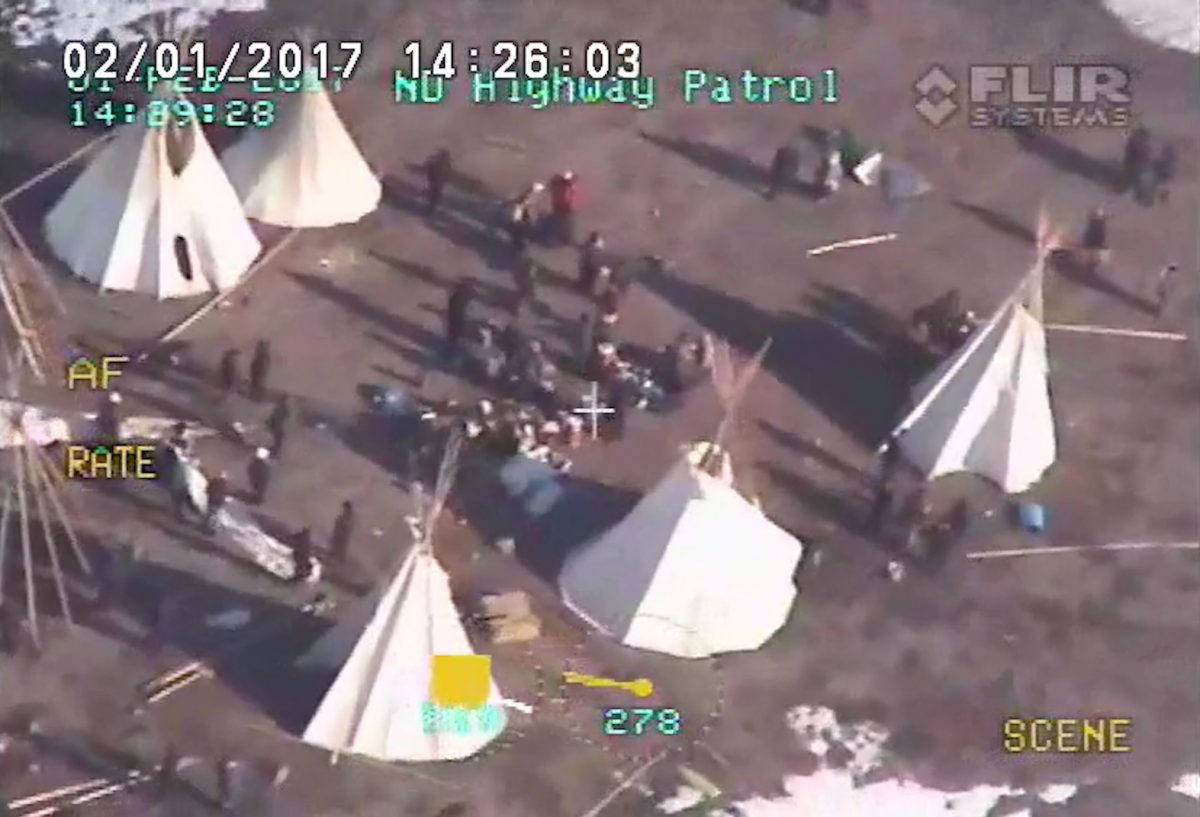
In April 2021, the company behind the Dakota Access Pipeline started trying to force Unicorn Riot to hand over sensitive and privileged materials developed in the process of covering the controversial fracked oil pipeline and the massive, historic Indigenous-led resistance against it. (See our full-length documentary, Black Snake Killaz [2017], DAPL category, and Standing Rock and DAPL content archives for dozens of original stories.)
We are grateful that we could provide coverage from Standing Rock territory, where thousands of people mobilized in a huge movement against the construction of the Dakota Access Pipeline. The Cheyenne River Sioux Tribe was also opposed to the pipeline due to its direct impact on the waters of Lake Oahe, on which they rely for spiritual practices and ceremonies. The pipeline endangers the health of Indigenous people and others downstream to this day, particularly members of the Standing Rock Sioux Tribe, who firmly opposed the pipeline project for years. It leaked five times in just its first half year of operation — part of an enormous spray of leaks from Energy Transfer’s poorly designed infrastructure.
Repression of Indigenous people is often a forerunner to expanded future campaigns. Much like today’s federalized National Guard operations against protests in California, the North Dakota National Guard took control of the protested pipeline construction area. The campaign to crush these protests included advanced tactics by private players, including an “Information War” by the National Sheriffs Association, and espionage by security firm Tigerswan in a “counterinsurgency” campaign. The FBI sent informants, and Customs and Border Protection deployed a Reaper drone for 281 hours over six months, similar to tactics recently seen against protests in Los Angeles.
Thanks to the nearly a thousand supporters who donated to our Legal Defense Fund we have been able to hang tough to protect our journalism from the multi-billion dollar oil company’s litigation campaign up to this point.
In December 2022, Hennepin County District Court Judge Joseph Klein ruled Unicorn Riot should produce a log of all privileged documents and answers. We appealed this privilege log ruling, while the DAPL attorneys appealed Klein’s finding that the MFFIA applied to our nonprofit media organization.
More than a year ago, in May 2024, Unicorn Riot won a strong ruling from the Minnesota Court of Appeals, rejecting the oil company Energy Transfer LP’s attempt to obtain newsgathering materials through a subpoena — the court affirmed that the Watergate era MFFIA “applies despite alleged unlawful conduct, exceptions must apply before district courts can order privilege logs from third parties.” The Minnesota Supreme Court decided to accept another appeal from Energy Transfer, which was argued in St. Paul in December 2024.
The ACLU added, “The court ruled today that the law does not contain an exception for journalists who are alleged to have engaged in illegal activity, but it did not categorically bar trial courts from ordering journalists to produce privilege logs in response to document requests – with notable caveats.”
The court recognized Unicorn Riot’s newsgathering activities were privileged under the MFFIA:
“We hold that the plain language of the MFFIA protects Unicorn Riot’s newsgathering activities during the Standing Rock Protests. Nothing in the statutory text leads us to believe that the privileged information that Unicorn Riot collected during the Standing Rock Protests should be excepted from the prohibition on disclosure under the MFFIA.”
Minnesota Supreme Court ruling in case A23-1284. (Energy Transfer LP (formerly known as Energy Transfer Equity, L.P.), et al., Appellants, vs. Greenpeace International (also known as Stichting Greenpeace Council), et al., Defendants, Unicorn Riot, et al., Respondents.)
“The Court’s decision is a welcome reminder that we value independent journalism in Minnesota,” said Teresa Nelson, legal director of the ACLU-MN, in a statement. “This win is particularly important as large corporations increasingly attempt to intimidate reporters through litigation and in the face of unprecedented attacks on the freedom of the press by the Trump administration and other government officials.”
The court gave some new direction to judges in Minnesota about privilege logs, a part of the discovery process that a lawyer called “time-consuming, tedious, onerous, beastly.”
“We find nothing in the text of the MFFIA that would prevent the district court from ordering production of a privilege log. With respect to many of Energy Transfer’s requests, we agree with the court of appeals that it is difficult to see how Unicorn Riot could produce a privilege log that would allow Energy Transfer to contest the validity of the privilege claims without identifying any privileged information. But we disagree with the court of appeals’ conclusion that the district court may never order a privilege log when a party claims privilege under the MFFIA. Producing a privilege log should not require a party to disclose privileged information in the log itself. And the MFFIA clearly protects parties from having to disclose privileged information to the district court. […] And district courts should be skeptical when reviewing a party’s request for information when the opponent claims privilege under the MFFIA, particularly when a party requests a vast amount of information that is very clearly privileged, as Energy Transfer did here.”
Minnesota Supreme Court ruling in case A23-1284.
In March 2025, in the parent case, Energy Transfer LP v. Greenpeace International, a local North Dakota jury found Greenpeace liable for $667 million in damages, which the environmental NGO is appealing.
Back in 2021, Alleen Brown and Sam Richards at The Intercept described Energy Transfer’s legal project as a “series of expensive conspiracy lawsuits against a disparate range of actors, [through which] the pipeline company has sought to paint the Standing Rock movement as the product of a vast misinformation-driven conspiracy to damage Energy Transfer.”
Trevor Timm at the Freedom of the Press Foundation described the subpoena as “a menacing attempt to intimidate a news outlet whose only ‘crime’ is being critical of the company,” — adding, “It should be thrown out immediately.”
We are also thankful for the support of many media industry and press freedom supporters, including the Reporters Committee for Freedom of the Press, and early coverage of our case by The Intercept. Tony Webster played a key role in supporting the entry of amicus briefs into our appeal; The Forum for Constitutional Rights also filed to support our position.
We are very thankful for the skills and persistence of our attorneys over the years fighting this case, including Chris Prozcko, Ryan Simatic, Teresa Nelson, Alicia Granse, Matthew Segal, and others who chipped in hours of research. We are also thankful for our current and former members who reported these stories from the front lines, sometimes injured and arrested, in cases that tested the boundaries of the First Amendment.
Consider donating to help our small media org recoup approx. $55,000 we spent on this court battle for press freedoms. We cannot thank our wonderful community of supporters enough!!
Legal Documents
2024-2025 Minnesota Supreme Court case:
- Energy Transfer LP v. Unicorn Riot: Respondents’ Brief (Oct. 21, 2024)
- ACLU Press release (July 16, 2025)
- Minnesota Supreme Court ruling (July 16, 2025)
Download the May 6 Minnesota Court of Appeals ruling here (PDF). Read the Amicus Briefs filed on Unicorn Riot’s behalf below:
- Forum for Constitutional Rights Amicus Brief (Nov. 6, 2023)
- Reporters Committee for a Free Press with Minnesota Newspaper Association (MNA), Silha Center for the Study of Media Ethics and Law, St. Paul Pioneer Press, Sahan Journal, American Civil Liberties Union of Minnesota (ACLU-MN), E.W. Scripps Company Amicus Brief (Nov. 3, 2023)
- Tony Webster Amicus Brief (Nov 3, 2023)
- “Court Holds Information, Like Unicorns, Should Be Free: Unicorn Riot and the Minnesota Shield Law” By Christopher Proczko (June 2024 – Media Law Letter)
Read other court documents below:
- Read the original subpoenas against Unicorn Riot (and Niko Georgiades, Unicorn Riot journalist) (Mar. 17, 2022)
- Energy Transfer filed a Motion to Compel UR and Georgiades to Comply with Subpoenas Duces Tecum (June 24, 2022)
- Read Unicorn Riot’s Memorandum in Opposition to Compel Compliance (Sept. 7, 2022)
- Energy Transfer filed another brief arguing to enforce the subpoena (Sept. 14, 2022)
- Judge Klein denied Energy Transfer’s motion to compel UR to comply with their third-party subpoenas, but the court ordered UR to produce privilege logs. You can read the ruling in full here. (Dec. 16, 2022)
- Three months after a March 31, 2023 court hearing, Judge Klein denied UR’s Motion for Relief (June 29, 2023)
- Read Unicorn Riot’s appeal here (Oct. 27, 2023)
- Read Energy Transfer’s appeal here (Sept. 27, 2023)
- Energy Transfer filed Appellants – Cross-Respondents Response and Reply Brief (Nov. 27, 2023)
- Unicorn Riot’s Respondents_Cross-Appellants’ Reply Brief (Dec. 11, 2023)
Minnesota Supreme Court to Hear Press Freedom Case Stemming From Dakota Access Pipeline Protests
Tuesday, December 10 at 9 a.m. CT/10 a.m. ET
Minnesota Judicial Center
690 Cedar St, Courtroom 300
St. Paul, MN 55155
Livestream of the hearing will be available here: https://www.mncourts.gov/SupremeCourt/OralArgumentLivestream.aspx
On Tuesday, Dec. 10, the Minnesota Supreme Court will hear oral arguments in Energy Transfer LP v. Greenpeace International, Unicorn Riot, in which the American Civil Liberties Union, the ACLU of Minnesota, and the law firm Biersdorf & Associates represent media organization Unicorn Riot and one of its member journalists. Unicorn Riot seeks to quash a subpoena for sensitive communications, recordings, and other unreleased newsgathering materials from the 2016 Dakota Access Pipeline (DAPL) protests.
Unicorn Riot journalists reported on the ground from the DAPL protests, gathering and publishing first-hand accounts. The oil company Energy Transfer, together with other plaintiffs, later sued the protesters in North Dakota and, in 2022, moved to compel disclosure of unpublished materials held by Unicorn Riot in Minnesota, alleging that trespassing made the materials unprotected. The Minnesota Court of Appeals held that Minnesota’s press shield law, the Free Flow of Information Act, protects the materials from disclosure, and Energy Transfer petitioned the Minnesota Supreme Court to take the case.
At the Minnesota Supreme Court, in October 2024 the ACLU filed a brief on behalf of Unicorn Riot arguing that the First Amendment, the Minnesota Constitution, and the Minnesota Free Flow of Information Act prohibit the compelled disclosure of newsgathering materials. The brief highlights that Energy Transfer seeks to conjure an unwritten exception to the state’s shield law, and that the law’s purpose would be severely undermined if “the statutory shield were to evaporate whenever, in the course of newsgathering, a reporter allegedly trespasses, speeds, jaywalks, or double-parks.”
We still need your support. We’ve spent over $50,000 battling this corporate energy giant and your monetary support has been so important - thank you, we're getting closer to our goal! Donations over $100 through the end of December 2024 will receive 11 × 17 movie posters of our feature length documentary film Black Snake Killaz: A #NoDAPL Story.
Recent writings on the case:
*Read a rundown of the case written in the Silha Center Bulletin (Winter/Spring 2024: Volume 29, No. 2)
*Minnesota Lawyer — Media collective wins pipeline appeal - Court says group needn’t turn over newsgathering materials (May 13, 2024)
*Unicorn Riot — Unicorn Riot Nets Resounding Win for Press Freedom Against Oil Corporation in Minnesota Appeals Court (May 10, 2024)
Background: Unicorn Riot and journalist member Niko Georgiades were served subpoenas in March 2021 as part of Energy Transfer/DAPL's lawsuit (filed in North Dakota state court) against Greenpeace and Indigenous water protectors, claiming they protested the pipeline for financial gain and not due to the potential environmental damage/harm to treaty rights.
(See updates in the update tab and for more information see these two articles: Pipeline Company Issues Broad Subpoena to News Site that Covered Protests Against It and CPJ calls on Energy Transfer to drop subpoenas to Unicorn Riot, journalist Niko Georgiades.)
The American Civil Liberties Union and the ACLU of Minnesota, together with the law firm Simatic & Biersdorf, PA, filed a brief in the Minnesota Supreme Court on Oct. 21 on behalf of nonprofit media organization Unicorn Riot, which seeks to quash a subpoena from oil company Energy Transfer stemming from the 2016 Dakota Access Pipeline (DAPL) protests. The brief asserts that the First Amendment and the Minnesota Free Flow of Information Act (MFFIA) protect Unicorn Riot from Energy Transfer’s attempts to subpoena sensitive communications, recordings, and other unreleased newsgathering materials from DAPL protests.
Oral arguments are set to be heard in Minnesota’s Supreme Court on Dec. 10, 2024 at 9 a.m. in the Minnesota Judicial Center, Courtroom 300.
“The First Amendment and Minnesota’s shield law protect journalists from attempts to use the courts to compel the disclosure of sensitive newsgathering information. A free press and the free flow of information to the public both depend on journalists’ ability to capture content and tell stories without fear of costly litigation that puts their unpublished materials at risk,” said Matthew Segal, senior staff attorney with the ACLU’s State Supreme Court Initiative.
Unicorn Riot journalists reported on the ground from the Dakota Access Pipeline protests, gathering and publishing first-hand accounts. In 2019, pipeline operator Energy Transfer sued individuals and entities that were allegedly involved with the protests.
In 2021, as part of the lawsuit, Energy Transfer issued subpoenas to Unicorn Riot and one of its member journalists seeking vast disclosures of unpublished materials. Unicorn Riot refused to surrender its material, and in 2022 – roughly six years after the protests – Energy Transfer moved to compel disclosure in Minnesota. In its motion papers, Energy Transfer alleged that Unicorn Riot had trespassed on its property while covering the protests. The Minnesota Court of Appeals earlier this year held that the Minnesota Free Flow of Information Act prohibits the compelled disclosure of newsgathering materials. Energy Transfer sought review at the Minnesota Supreme Court, which agreed to hear the case.
“This case is about more than just our small media organization. It represents the broader fight for the right to gather and disseminate information freely, without corporate interference — an essential cornerstone of press freedom,” said Unicorn Riot.
The brief highlights that Energy Transfer seeks to conjure an unwritten exception to the MFFIA. The brief explains that the MFFIA contains only two exceptions to the law that would allow compelled disclosure — one for certain criminal cases and one for certain defamation cases — and because neither exception applies here, the Minnesota Supreme Court should uphold the court of appeal’s reading of the law.
The purpose of the Minnesota Free Flow of Information Act, the brief continues “is to promote newsgathering and publication, and that purpose would be severely undermined if the statutory shield were to evaporate whenever, in the course of newsgathering, a reporter allegedly trespasses, speeds, jaywalks, or double-parks.”
“Protecting journalists and their sources makes all of us better informed and better members of our community,” said ACLU-MN Staff Attorney Alicia Granse.
The brief is online here: https://www.aclu.org/documents/energy-transfer-lp-v-unicorn-riot-respondents-brief
Related Documents:
We need your support now more than ever. We’ve spent over $50,000 battling this corporate energy giant and your monetary support has been so important - thank you! Donations over $100 through the end of December 2024 will receive 11 × 17 movie posters of our feature length documentary film Black Snake Killaz: A #NoDAPL Story.
Recent writings on the case:
*Read a rundown of the case written in the Silha Center Bulletin (Winter/Spring 2024: Volume 29, No. 2)
*Minnesota Lawyer — Media collective wins pipeline appeal - Court says group needn’t turn over newsgathering materials (May 13, 2024)
*Unicorn Riot — Unicorn Riot Nets Resounding Win for Press Freedom Against Oil Corporation in Minnesota Appeals Court (May 10, 2024)
Background: Unicorn Riot and journalist member Niko Georgiades were served subpoenas in March 2021 as part of Energy Transfer/DAPL's lawsuit (filed in North Dakota state court) against Greenpeace and Indigenous water protectors, claiming they protested the pipeline for financial gain and not due to the potential environmental damage/harm to treaty rights.
(See updates in the update tab and for more information see these two articles: Pipeline Company Issues Broad Subpoena to News Site that Covered Protests Against It and CPJ calls on Energy Transfer to drop subpoenas to Unicorn Riot, journalist Niko Georgiades.)
The Minnesota Supreme Court granted Energy Transfer’s Petition for Review (PFR) on August 6, 2024, and our years-long case to secure press freedoms continues in the Minnesota courts.
View the order granting Energy Transfer’s PFR here (August 6, 2024).
We need your support now more than ever. We’ve spent over $50,000 battling this corporate energy giant and your monetary support has been so important - thank you! Donations over $100 from the month of August through the end of December 2024 will receive 11 × 17 movie posters of our feature length documentary film Black Snake Killaz: A #NoDAPL Story. We'll continue to provide updates on the case.
Background: Unicorn Riot and journalist member Niko Georgiades were served subpoenas in March 2021 as part of Energy Transfer/DAPL's lawsuit (filed in North Dakota state court) against Greenpeace and Indigenous water protectors, claiming they protested the pipeline for financial gain and not due to the potential environmental damage/harm to treaty rights. DAPL has attempted to get UR to give out sensitive and privileged materials. For further information, read the other updates on the legal fund donor page.
Recent writings on the case:
*Read a rundown of the case written in the Silha Center Bulletin (Winter/Spring 2024: Volume 29, No. 2)
*Minnesota Lawyer — Media collective wins pipeline appeal - Court says group needn’t turn over newsgathering materials (May 13, 2024)
*Unicorn Riot — Unicorn Riot Nets Resounding Win for Press Freedom Against Oil Corporation in Minnesota Appeals Court (May 10, 2024)
(Update June 11, 2024) Energy Transfer Appeals to Minnesota Supreme Court After Unicorn Riot’s Win in Appeals Court
Continuing its three-plus year quest to have the courts force Unicorn Riot to hand over documents, oil company Energy Transfer filed an appeal to the Minnesota Supreme Court on June 5, 2024. This follows the May 6 ruling favoring Unicorn Riot by the Minnesota Court of Appeals that rejected ET’s attempts to obtain newsgathering materials through a subpoena.
[Read Energy Transfer’s Petition for Review here (June 5, 2024)]
[Read the Minnesota Appeals Court Ruling here (May 6, 2024)]
So far we’ve spent $50,000 battling the energy company that owns Dakota Access Pipeline and we won the initial battle! Thanks so much to the 700-plus donations that helped us to do this! However, we still need your support to help recoup some of those costs and help us continue our battle as new costs are arising - donate today!
Recent writings on the case:
*Read a rundown of the case written in the Silha Center Bulletin (Winter/Spring 2024: Volume 29, No. 2)
*Minnesota Lawyer — Media collective wins pipeline appeal - Court says group needn’t turn over newsgathering materials (May 13, 2024)
*Unicorn Riot — Unicorn Riot Nets Resounding Win for Press Freedom Against Oil Corporation in Minnesota Appeals Court (May 10, 2024)
Background: Unicorn Riot and journalist member Niko Georgiades were served subpoenas in March 2021 as part of Energy Transfer/DAPL's lawsuit (filed in North Dakota state court) against Greenpeace and Indigenous water protectors, claiming they protested the pipeline for financial gain and not due to the potential environmental damage/harm to treaty rights.
(See updates in the update tab and for more information see these two articles: Pipeline Company Issues Broad Subpoena to News Site that Covered Protests Against It and CPJ calls on Energy Transfer to drop subpoenas to Unicorn Riot, journalist Niko Georgiades.)
The Minnesota Court of Appeals issued a ruling favoring Unicorn Riot on Monday, May 6, rejecting the oil company Energy Transfer LP’s attempt to obtain newsgathering materials through a subpoena, blunting a three-year legal pressure campaign.
In April 2021, the company behind the Dakota Access Pipeline started trying to force Unicorn Riot to give out sensitive and privileged materials developed in the process of covering the controversial fracked oil pipeline and the massive, historic organized resistance against it. (See our full-length documentary, Black Snake Killaz [2017], DAPL category, and Standing Rock and DAPL content tags for dozens of original stories.)
With the help of nearly 700 supporters chipping into our DAPL Legal Defense Fund (Thank you SOOO much), Unicorn Riot fought this subpoena every step of the way in the Minnesota court system — and the fight continues as the Minnesota Court of Appeals remanded some legal questions back to the district court. (We also need support for other ongoing legal matters.)
Unicorn Riot’s lead attorney, Chris Prozcko at Sapientia Law Group, noted the crucial work of fellow attorney Ryan Simatic as well as persuasive amici briefs from the Reporters Committee for Freedom of the Press, the Forum for Constitutional Rights and Tony Webster — all of whom brought important press freedom factors the court had to consider. Prozcko wrote:
“Free Press Victory in Minnesota Court of Appeals – [the Minnesota Free Flow of Information Act. or MFFIA] applies despite alleged unlawful conduct, exceptions must apply before district courts can order privilege logs from third parties
The Minnesota Court of Appeals issued the attached opinion in Energy Transfer LP v. Greenpeace International, addressing the application of the Minnesota Free Flow of Information Act when asserted in response to a third-party subpoena. We represent Unicorn Riot, a non-traditional media collective that resisted subpoenas from a conglomerate of companies that constructed and own the Dakota Access Pipeline seeking newsgathering materials to support tort claims against several activist organizations and demonstrators. The district court determined that the MFFIA protected Unicorn Riot but nonetheless ordered it 1) to produce a privilege log of all documents responsive to the subpoenas, and 2) to produce responsive materials to the court upon request for in camera review. Energy Transfer appealed the MFFIA determination, and Unicorn Riot appealed the privilege log requirement.
This morning [May 6], the Court of Appeals handed down a resounding win for the free press. As to the first issue, the court rejected Energy Transfer’s argument that the MFFIA does not protect information acquired during or related to a purported newsgatherer’s unlawful conduct and affirmed that the state shield law protects Unicorn Riot’s newsgathering materials related to the DAPL protests. The Court of Appeals also held that it was error for the district court to order Unicorn Riot to produce a privilege log and to produce privileged records for in camera review upon request without first determining that an exception to the shield law applies.
Special thanks go to Ryan Simatic for his invaluable efforts on this appeal, as well as the amici that supported Unicorn Riot’s position–specifically the Reporters Committee for Freedom of the Press, the Forum for Constitutional Rights, and Tony Webster. Their efforts ensured that the court had a wide-angle perspective on the issues before it and the importance of press protections.
Chalk up another one for the good guys.”
Christopher Proczko, Sapienta Law Group, May 6, 2024
Back in 2021, Alleen Brown and Sam Richards at The Intercept described Energy Transfer’s legal project as a “series of expensive conspiracy lawsuits against a disparate range of actors, [through which] the pipeline company has sought to paint the Standing Rock movement as the product of a vast misinformation-driven conspiracy to damage Energy Transfer.”
Trevor Timm at the Freedom of the Press Foundation described the subpoena as “a menacing attempt to intimidate a news outlet whose only ‘crime’ is being critical of the company” — adding “It should be thrown out immediately.” While some issues are still to be adjudicated, the lower court’s privilege log order has now been thrown out.
This ruling comes amid challenging times for the media industry as a whole: layoffs are mounting across the industry, while litigation and funding woes are pressuring media organizations to retreat from challenging coverage. The Fifth Circuit issued a “disastrous ruling” in Villarreal v. City of Laredo, Texas, which drastically eroded press freedom.
Support among philanthropists for nonprofit media is fading along with mounting media distribution problems, although some are joining larger networks in hopes of turning things around. At least in Minnesota, power players won’t be able to use certain legal avenues to harass media organizations and try to grab their newsgathering materials anymore, thanks to this new ruling favoring Unicorn Riot.
Thanks so much for your support! Please spread this legal fund to your friends. We still need support to recoup some of the $50K spent and the $30K+ that we're in the hole.
Unicorn Riot’s ongoing legal battle against Energy Transfer recently reached a new phase. Both Unicorn Riot and Energy Transfer have filed appeals, extending our years-long court case. To acknowledge the jeopardy to press freedoms in our case, numerous press rights advocates, along with legacy media and non-profit media organizations, filed multiple amicus briefs (legal documents filed in a court case by individuals or groups who are not parties to the case but have an interest in the outcome), in support of Unicorn Riot. A broad spectrum of groups and individuals recognize what’s at stake in this case. Excerpts from the briefs:
The Forum for Constitutional Rights said, “Unicorn Riot falls squarely within the [Minnesota Free Flow of Information Act’s] broad protective shield. Unicorn Riot is a non-traditional, decentralized, Internet-based media outlet—but that does not alter Unicorn Riot’s much noted record of news gathering, procuring, compiling, editing and publishing.”
Their brief goes on to say, “Unicorn Riot’s non-traditional—but MFFIA-protected—approach to news-gathering has redefined journalism, as illustrated by the Floyd protests and civil unrest.”
The Reporters Committee for Freedom of the Press and several other legacy media organizations, said, “Wide-ranging subpoenas that demand ‘[a]ll videos, audio recordings, images, reports, articles, letters, emails, press releases, statements, internet postings or content,’ like the one at issue in this case, are particularly burdensome for news organizations. Fighting—sometimes lengthy and costly—legal battles to protect their work product, a journalist’s time and resources are taken away from crucial reporting efforts… Ultimately, it is the public that suffers the consequences.”
And a lawyer representing award-winning freelance journalist Tony Webster said, “The news media relies on the protections of the MFFIA and First Amendment when doing their work, and the District Court’s order requiring a privilege log upends those protections, threatening not just the news media and their sources, but the right and interests of the public in staying informed.”
Amicus Briefs Filed on Unicorn Riot’s Behalf
Forum for Constitutional Rights Amicus Brief (November 6, 2023)
Reporters Committee for a Free Press with Minnesota Newspaper Association (MNA), Silha center for the Study of Media Ethics and Law, St. Paul Pioneer Press, Sahan Journal, American Civil Liberties Union of Minnesota (ACLU-MN), E.W. Scripps Company Amicus Brief (Nov 3, 2023]
Tony Webster Amicus Brief (Nov 3, 2023
[Read Unicorn Riot’s appeal here (Oct. 27, 2023)]
[Read Energy Transfer’s appeal here (Sept. 27, 2023)]
We are in need of your continued support. Our legal fees have now exceeded $42,000. Help us reach our legal fund fundraiser goal of $50,000. Please consider making a tax-deductible donation to our legal fund today of any amount - and kindly also share with anyone in your network who may also want to contribute. Your donation goes not only to help us, but all those who strive for a free and independent press!
On June 29, 2023, UR’s motion challenging the Minnesota District Court’s December 2022 order requiring it to produce a privilege log was denied. Energy Transfer/DAPL appealed the court’s original order that found that UR and its journalists are protected by the Minnesota Free Flow of Information Act. [Read appeal.] Before the end of October, we will be filing our own brief supporting the court’s ruling that the shield law protects us and challenging its requirement that we produce a privilege log in violation of our rights under the MFFIA and the First Amendment.
We want to express our gratitude to our many supporters who have generously donated to our legal fundraiser over the past two years. We could not have come this far without your unwavering support!
As we approach what we hope will be the final stages of this long and challenging legal battle, we are in need of your continued support. While we have raised around $20,000 to date, our legal fees have exceeded just over $30,000 – and we are less than halfway to our legal fund fundraiser goal of $50,000. We humbly request that if you or anyone you know can contribute, regardless of the amount, please consider making a tax-deductible donation to our legal fund today. Your donation goes not only to help us, but all those who strive for a free and independent press!
Background: Unicorn Riot and journalist member Niko Georgiades were served subpoenas in March 2021 as part of Energy Transfer/DAPL's lawsuit (filed in North Dakota state court) against Greenpeace and Indigenous water protectors, claiming they protested the pipeline for financial gain and not due to the potential environmental damage/harm to treaty rights. (See our original posting below for more information and these two articles: Pipeline Company Issues Broad Subpoena to News Site that Covered Protests Against It and CPJ calls on Energy Transfer to drop subpoenas to Unicorn Riot, journalist Niko Georgiades.)
First, we’d like to say thank you to our great community for sticking with us through this drawn out legal battle. This struggle has grown into one concerning the fundamental protections needed to ensure a free press, and we couldn’t have mounted the defense we have up to this point without your support. With that, we have some updates concerning this case that we can now share with you.
In Dec. 2022, after nearly three months of waiting, Judge Klein denied Energy Transfer’s motion to compel Unicorn Riot to comply with their third-party subpoenas, but the court ordered UR to produce privilege logs. You can read the ruling in full here.
Seeing the process of producing a privilege log as not only burdensome, but an imposition on our First Amendment rights as an independent media outlet, we chose to fight that ruling and our attorney submitted a motion of relief from the order of producing a privilege log. A court hearing was held on March 31 over that motion and a ruling is expected in the coming months.
As we wait for that ruling, the fight is certain to continue, and further court hearings and filings are likely to occur over the next several months. This whole ordeal has been very expensive for our small nonprofit organization and we don’t know when the situation will be resolved.
We need your continued help and support to push us through this and ensure we can continue to do our work without draining our limited resources. Right now, our ability to keep reporting on the stories you care about is at risk due to interference from an oil corporation’s lawsuit against activists that we are not a party to. The appeal process is estimated to cost us $35,000. This brings our total legal fees fighting this issue to nearly $50,000. If you’re financially privileged or know someone who is, please consider making a tax-deductible donation to our legal fund. Thank you for helping us make this stand for a free and independent press!
Energy Transfer/DAPL is continuing their quest to get the Minnesota District Courts to order Unicorn Riot (UR) to give up newsgathering materials from our coverage of the resistance to the Dakota Access Pipeline.
After a year of silence from the corporation, Energy Transfer filed a Motion to Compel UR and Niko Georgiades (UR journalist) to Comply with Subpoenas Duces Tecum on June 24, 2022. Last week on September 7, UR's counsel filed a Memorandum in Opposition to Compel Compliance and asked the court to squash quash the subpoenas against Unicorn Riot (and Georgiades). Energy Transfer filed another brief on September 14 arguing to enforce the subpoena.
An upcoming court hearing is scheduled on September 21, 2022, at 10:00 a.m. central time to allow Energy Transfer/DAPL to "move the Court" for an order to compel UR to give DAPL our documents.
Information to attend via Zoom can be found below. The hearing is also open to public attendance in person.
(Court record with Zoom link and login information.)
Thanks to your support, UR has been able to retain legal counsel to help us protect the integrity of our reporting. If you want to contribute to the ongoing costs of our legal needs, consider supporting us with a one-time donation or as a monthly recurring supporter. Thanks!
Background: Unicorn Riot and journalist member Niko Georgiades were served subpoenas in March 2021 as part of Energy Transfer/DAPL's lawsuit (filed in North Dakota state court) against Greenpeace and Indigenous water protectors, claiming they protested the pipeline for financial gain and not due to the potential environmental damage/harm to treaty rights. (See our original posting below for more information and these two articles: Pipeline Company Issues Broad Subpoena to News Site that Covered Protests Against It and CPJ calls on Energy Transfer to drop subpoenas to Unicorn Riot, journalist Niko Georgiades.)
*Donations to the legal fund are placed in our general operating account and allocated to legal expenses.*
UPDATE: We wanted to thank you for your support and give you all a quick update. UR has retained legal representation and has submitted legal motions before the court. It’s too early to tell what the next steps will be, but we have retained a top-notch First Amendment lawyer to vigorously defend us. UR is hoping for a quick resolution to this subpoena. In the interest of transparency, we are establishing a dedicated legal defense fund with any left over funds.
We are fortunate to have the support of numerous press freedom organizations such as the Committee to Protect Journalists. CPJ's Program Director Carlos Martinez de la Serna said in a statement, "[i]t is disgraceful that a multibillion-dollar company is trying to compel a nonprofit news organization and one of its reporters to turn over unpublished source material over four years after it was collected”. We know that Energy Transfer, the company behind the Dakota Pipeline, is going to extreme lengths to go after UR and our reporting but refuse to be silenced.
We are extremely grateful for your support and it has enabled us to continue to report on groundbreaking issues. We ask that you follow us on across social platforms to learn more about our work.
In Gratitude,
Unicorn Riot