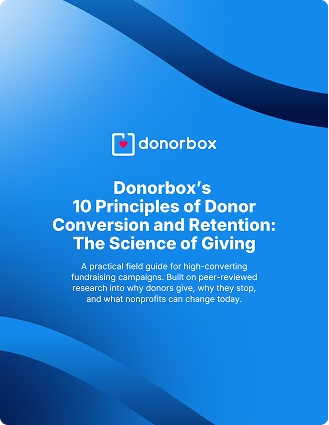
What makes a donor give, and then give again?

Research shows nonprofits lose roughly 50% of first-time donors. Download this free field guide to learn 10 simple, science-backed principles that build donor trust and make giving effortless.

Cocer

Built on real donor science and tested on live fundraising pages

Grounded in research from leading academic journals, including the Journal of Marketing and Urban Institute.

The Science of the Giving Decision

Two hidden forces determine whether a donor gives or walks away: Confidence and Friction. Here is a look of what you'll learn inside:

The 6 Confidence Builders

The Problem: Most donation pages accidentally make donors hesitate, doubt security, or feel confused before they even fill out the form.

Inside the Guide: Discover 6 simple psychological triggers that build instant trust and prove to donors that their money is safe.

icon

The 4 Friction Removers

The Problem: Extra from questions, slow mobile load times, and too many choices ruin giving rates for donors who wanted to give.

Inside the Guide: Master 4 fast design fixes that remove mental fatigue, speed up mobile checkout to under 3 seconds, and turn one-time givers into repeat supporters.

icon

The Campaign Execution Toolkit

The Problem: Research is useless if you need a software engineer or a big budget to use it.

Inside the Guide: Master 4 fast design fixes that remove mental fatigue, speed up mobile checkout to under 3 seconds, and turn one-time givers into repeat supporters.

icon

Losing Donors Is a Page Design Failure, Not a Marketing Failure

50% Donor Loss
Half of all new donors never give a second time because of confusing checkout forms and poor thank-you steps.

21% Higher Gifts
Donors who get a quick thank-you give 21% more on their next donation – yet only 39% of donors ever get thanked.
53% Mobile Drop-Off
Page delays over 3 seconds cause more than half of mobile visitors to leave without giving.

Donorbox's 10 Principles of Donor Conversion & Retention

Watch now for a first look at the science behind every donor decision. Download the full field guide for the full framework and a practical checklist to put it to work.

The Science of Giving: What Donors Want

Frequently Asked Questions

What is the Science of Giving?

It's Donorbox's set of ten principles for getting donors to give and keep giving. We built it from published research on donor behavior, and it covers two jobs: making donors feel confident in you, and taking the friction out of giving.

What are the ten principles?

Six are about confidence: transparency, credibility, congruence, security, impactful messaging and reciprocation. Four are about friction: attention, reduced cognitive load, easily repeated and accessibility. In plain terms, donors give when they trust you and when giving is easy, and these ten cover both.

Why do donors stop after their first gift?

Most of the time they just don't come back. About half of new donors never give a second time (Kim et al., 2021). The research links coming back to trust, credibility, satisfaction and how well an organization communicates (Roberson, 2015).

How fast should a donation page load?

Aim for under three seconds on a phone. Google's 2016 research found that 53% of mobile visits were abandoned when a page took longer than that (Google, "The Need for Mobile Speed"). The study looked at mobile sites in general, not donation pages, but donors are unlikely to be more patient.

How soon should you thank a donor?

As soon as you can. Only 39% of donors are thanked or recognized, and donors who were thanked said they would give 21% more next time (Merchant et al., 2010). The research doesn't name a deadline. Our advice is a personal thank you within 48 hours. The guide covers this under Reciprocation.

Is this research peer reviewed?

Not the framework itself. The ten principles are Donorbox's own work and haven't been through a journal's peer review. They're built on published academic studies, mostly from peer reviewed journals, and each claim links to its source so you can check it.

Do I need technical skills to use these 10 principles?

No. Every principle ends with a Do This Now list of small steps. Most are about wording, layout and follow up, so you don't need to code. A few, like page speed, may need a developer or your donation platform's support team.

How does this guide help me plan my campaign?

It includes a 6 step campaign plan and a 10 point checklist for testing your donation page before you launch.

G2 Leader in Fundraising & Donor Management

Trusted by world-changers big and small

Trusted by organizations around the world

$4B+
Donations raised
300,000+
Fundraising campaigns
200,000+
Organizations trust us
96+
Countries served

Turn Your Donation Page into an Easy Success

Stop losing donations at checkout. Download the free guide to check your fundraising setup and turn single gifts into long-term support.